Gasoline Engine: Fundamentals and Operation
You do not need to be an engineer to understand what is happening under your hood. After reading this, you will know the four-stroke cycle well enough to explain it to a friend, understand why your engine needs spark, fuel, air, and compression to run, and be able to diagnose a rough idle or a no-s…
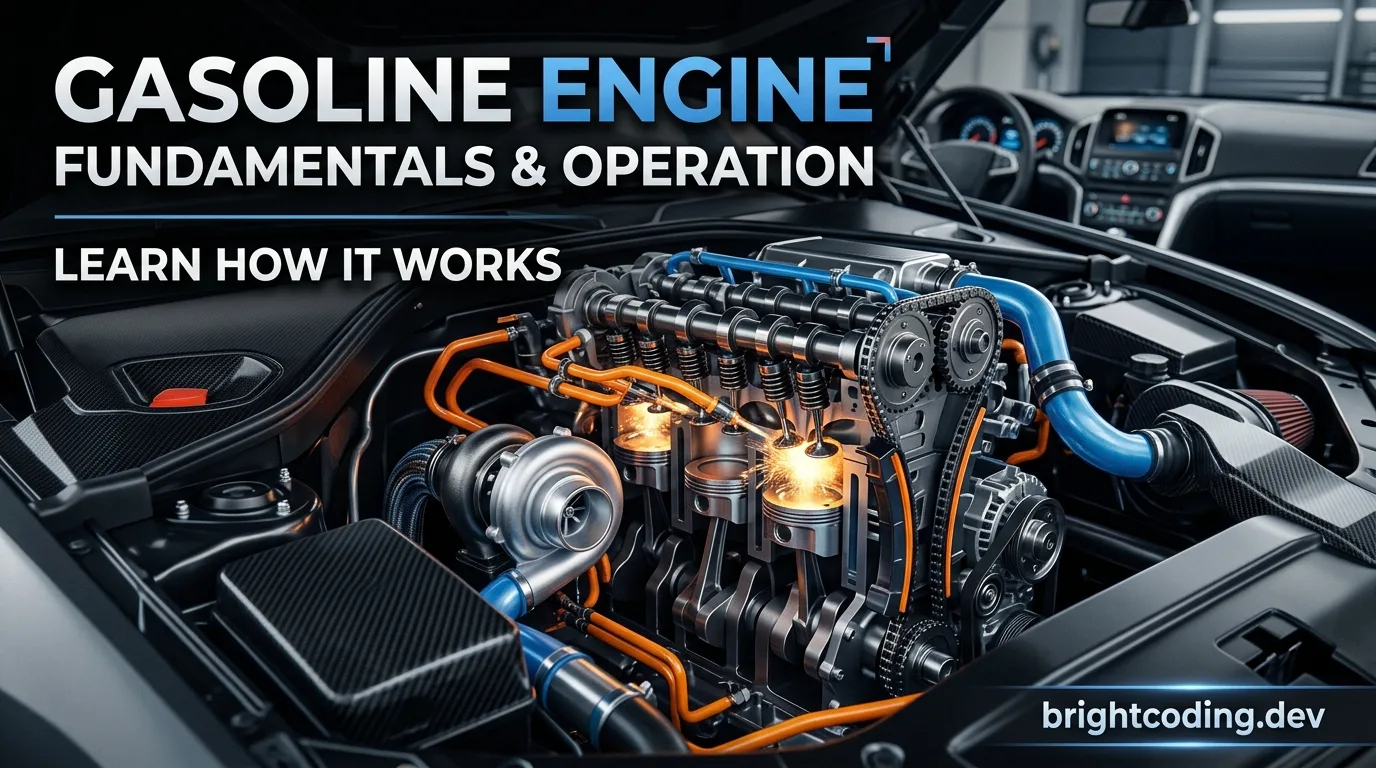
You do not need to be an engineer to understand what is happening under your hood. After reading this, you will know the four-stroke cycle well enough to explain it to a friend, understand why your engine needs spark, fuel, air, and compression to run, and be able to diagnose a rough idle or a no-start with more confidence. Plan on 20 to 30 minutes for the read, plus whatever time you spend actually poking around your own engine.
The goal here is not to turn you into a mechanic. It is to stop you from nodding politely when someone says "you're losing compression on cylinder three" while you quietly wonder if that is bad. It is bad. Here is why.
What you need before you start
You do not need much to follow along. If you want to get hands-on with your own car while reading, grab:
- Your owner's manual (seriously, it has the firing order and fluid specs)
- A basic socket set and a screwdriver set
- A spark plug socket if you plan to pull a plug
- Safety glasses and nitrile gloves
- A rag or two
- A cheap OBD2 scanner or a phone app with a Bluetooth dongle (optional but helpful)
No special tools required for the theory. For the hands-on checks, the basics above will cover 90 percent of what is described here.
Step 1: Understand what a gasoline engine actually does
A gasoline engine converts the chemical energy in fuel into rotating motion. It does this by burning a mixture of gasoline vapor and air inside a sealed chamber, which pushes a piston down, which turns a crankshaft, which eventually turns your wheels.
That is the whole trick. Everything else, the fuel injection, the ignition coils, the sensors, the computer, exists to make that burn happen at the right moment, in the right amount, over and over, thousands of times per minute.
Why it matters: Once you see the engine as an air pump that happens to burn fuel, most diagnosis gets easier. If it runs badly, one of four things is usually wrong: air, fuel, spark, or compression.
Practical tip: Remember the four. When your car acts up, ask which of the four is most likely. That single question solves more problems than any scan tool.
Step 2: Learn the four strokes
Almost every gasoline engine you will ever work on uses the four-stroke cycle. Here is what happens inside one cylinder:
Intake stroke. The piston moves down and the intake valve opens. Air and fuel get pulled in.
Compression stroke. Both valves close. The piston moves up and squeezes the mixture. This is where compression matters, and where a worn engine starts to show its age.
Power stroke. The spark plug fires. The mixture burns and expands fast, driving the piston down. This is the only stroke that makes power.
Exhaust stroke. The exhaust valve opens and the piston pushes burned gases out.
Then it starts over. At idle, each cylinder does this roughly 12 to 15 times per second. At highway speed, it is much faster.
Why it matters: If you know the sequence, you can reason about timing. A car that cranks but will not start might have spark at the wrong time, or no compression, or no fuel. The four strokes tell you what to check first.
Practical tip: A four-cylinder engine at 3,000 rpm is doing about 6,000 power strokes per minute across all cylinders. That is why a single misfire every few seconds is easy to miss by ear but shows up instantly on a scan tool.
Step 3: Map the air and fuel path
Air enters through the air filter, flows past a mass airflow sensor on most modern cars, through the throttle body, into the intake manifold, and down to the intake valves. Fuel is added either just before the intake valve (port injection) or directly into the cylinder (direct injection).
The engine computer decides how much fuel to add based on how much air is coming in, how hot the engine is, and what the oxygen sensors in the exhaust are reporting.
Why it matters: A dirty mass airflow sensor or a clogged air filter throws off that calculation. The engine runs lean or rich, you feel a stumble, and the check engine light comes on. The fix is often cheap.
Practical tip: If your check engine light is on and the car feels down on power, start by pulling the codes. A free OBD code lookup tells you what the code means in plain language before you start guessing at parts.
Step 4: Follow the spark
The ignition system has to deliver a spark at exactly the right instant, thousands of times per minute. On older cars, a distributor handled this. On anything built in the last 20 years, you have coil-on-plug or a coil pack, and the computer fires each cylinder individually.
The spark plug sits in the combustion chamber. Over time, the gap wears, the electrode erodes, and the plug gets harder to fire, especially under load.
Why it matters: Worn plugs cause misfires, rough idle, and poor fuel economy. They are also one of the cheapest things you can replace yourself.
Safety warning: If you are pulling a plug or coil, disconnect the negative battery terminal first, and never touch the coil or plug boot while the engine is running. Ignition systems can deliver a nasty shock.
Practical tip: Pull one plug and look at it. Light tan or grey is normal. Black and sooty means rich. Oily means you have a bigger problem. White and blistered means lean or overheating. The plug is a free diagnostic report on that cylinder.
Step 5: Check the battery and charging system first
Half the "my engine won't start" calls I have seen end with a battery that is four years old and tired. The engine needs a strong crank to build compression. A weak battery cranks slowly, the computer sees low voltage, and everything acts weird.
Check the battery terminals for corrosion. Check the voltage with a multimeter if you have one. A healthy resting battery is usually around 12.4 to 12.7 volts; anything under 12.2 is suspect. Verify that range against your manual or a shop before you replace anything.
Why it matters: A no-start that looks like a fuel or spark problem is sometimes just a weak battery. It costs nothing to rule out.
Safety warning: Batteries produce hydrogen gas and can vent explosive fumes. Do not smoke or create sparks near one. Wear eye protection, and remove the negative cable first when disconnecting, positive first when reconnecting.
Practical tip: If the car cranks slowly and the lights dim, it is the battery or the connections. If it cranks fast and still will not fire, look at fuel or spark.
Step 6: Understand compression, and why it matters most
Compression is the engine's ability to seal the combustion chamber. If the piston rings, valve seats, or head gasket are worn or damaged, compression drops, and the engine loses power and efficiency.
You can test this with a compression gauge, but on many modern engines access is tight and the test takes patience. A leak-down test tells you where the pressure is escaping: rings, intake valve, exhaust valve, or head gasket.
Why it matters: Low compression on one cylinder is the classic reason for a persistent misfire that new plugs and coils will not fix. It is also the difference between a cheap repair and an engine rebuild.
Practical tip: If a misfire code keeps coming back on the same cylinder after you have replaced the coil and plug, get a compression or leak-down test before you throw more parts at it. This is a good moment to use the AI mechanic assistant to help you interpret the symptoms and decide what to test next.
Step 7: Watch the exhaust and the sensors
The exhaust system tells the engine computer how the burn went. Oxygen sensors before and after the catalytic converter measure oxygen content in the exhaust, and the computer adjusts fuel trim based on what they report. If fuel trim drifts far from zero, you have a vacuum leak, a bad sensor, or a fuel delivery problem.
Why it matters: Fuel trim numbers are one of the most useful things you can look at without tearing anything apart. They tell you what the engine is doing, not what you think it is doing.
Practical tip: If you have a scan tool that shows live data, watch short-term and long-term fuel trim at idle and at cruise. A live OBD data tool makes this much easier than reading raw values. If trims are pinned positive at idle and normalize at speed, suspect a vacuum leak. If they are pinned positive everywhere, suspect fuel delivery.
Step 8: Know the common failure points
Most gasoline engine problems land in a handful of buckets:
- Ignition: plugs, coils, wires, or a failing crank or cam sensor
- Fuel: clogged injectors, weak fuel pump, dirty filter
- Air: vacuum leaks, dirty MAF, stuck throttle body
- Compression: worn rings, burnt valve, blown head gasket
- Sensors and control: oxygen sensors, coolant temp sensor, computer faults
If you can name which bucket your symptom belongs to, you are already ahead of most people who just start swapping parts.
Practical tip: Before you buy anything, write down the symptom, the conditions (hot, cold, idle, load), and any codes. That three-line note is what a good mechanic needs to help you, and it is what an AI diagnostic helper uses to point you in the right direction.
Pro tips
- Change your air filter on schedule. It is cheap and it matters more than most people think.
- Use the correct octane. Higher octane does not make more power in an engine designed for regular; it just costs more.
- Do not ignore a flashing check engine light. Flashing usually means an active misfire that can damage the catalytic converter. Stop and diagnose.
- Keep a cheap OBD2 dongle in the glovebox. The moment a light comes on, you can read the code before you forget what the car was doing.
- Check your oil level monthly. Oil does more than lubricate; it helps seal the rings and manage heat.
- Learn your car's normal. If you know how it sounds and feels when it is healthy, you will notice the small changes early.
Common pitfalls
Throwing parts at a code. A P0301 misfire code does not mean "replace coil." It means cylinder one misfired. Test first, then replace.
Ignoring basic maintenance. Old plugs, a dirty filter, and old oil cause more driveability complaints than any single sensor failure.
Assuming the worst. A rough idle is often a vacuum leak or a dirty throttle body, not a blown engine. Check the cheap things first.
Disconnecting the battery to "reset" everything. On many cars this clears adaptive fuel trims and can make the car run worse for a while. It also wipes emissions readiness monitors, which can fail an inspection. Clear codes with a scan tool instead.
Working on a hot engine. Let it cool. Hot coolant, hot exhaust, and hot oil all burn. This is not a suggestion.
Useful resources
For step-by-step procedures specific to your car, the step-by-step car guides section is a good starting point. If you want to decode a fault code, the free car tools collection includes the OBD lookup and other diagnostic helpers. When you just want to know what a component does, the mechanical encyclopedia covers the parts in plain language. And if a symptom is nagging you and you cannot place it, the car symptom finder narrows it down fast. For general maintenance reading, the AutoTools blog has plenty more.
FAQ
Do I really need premium gas? Only if your owner's manual says so. Engines designed for regular do not benefit from premium. Engines that require premium can be damaged by regular under load. Check the manual.
How often should I change spark plugs? It varies widely. Some plugs last 30,000 miles, some last 100,000. Check your maintenance schedule. Pull one and look at it if you are unsure.
Why does my engine misfire only when cold? Cold-start misfires often point to weak ignition under load, a dirty injector, or a sensor reading off when cold. It is worth scanning for pending codes even if the light is not on yet.
Can I diagnose an engine problem without a scan tool? You can narrow it down, but modern engines rely on the computer for fuel and spark timing. A basic scanner is a worthwhile investment for any DIYer.
What does "blown head gasket" actually mean? The gasket between the cylinder head and the engine block has failed, so coolant, oil, and combustion gases can mix or leak where they should not. Symptoms include white smoke, coolant loss with no visible leak, and overheating. It is a serious repair.
Final thought
You do not have to know everything about your engine to take better care of it. You just have to know the four things it needs, how to read the clues it gives you, and when to stop and get help. That is most of the game. Now go pull a spark plug and see what it tells you.
Related articles

10 Signs Your Petrol or Diesel Engine Is Starting to Fail
Your engine rarely dies without warning. It whispers first, then talks, then screams. Most drivers only start listening at the screaming stage, which is when the repair bill has already tripled.
Read the article →
Petrol vs Diesel: Which Engine Is Cheaper to Maintain?
You are standing in a dealer lot or scrolling through listings, and the same question keeps surfacing: petrol or diesel? The sticker price is only half the story. What you actually pay over five or seven years depends on servicing, parts, fuel, and how the car is driven. That is where the petrol vs…
Read the article →
Petrol vs Diesel Engine: Which One Is Really Better in 2026?
Buying a car in 2026 means you cannot dodge the petrol versus diesel question, especially if you are shopping used or looking at a nearly-new car that still has a combustion engine under the hood. Read this and you will know how to match the engine to your actual driving, work out what the fuel and…
Read the article →
Carburetor vs. Fuel Injection: Which System Is Better?
You already know the short answer: fuel injection wins on paper. It has won in showrooms for decades, and there is no serious argument left about which system meters fuel more precisely. So why does the question still come up in the bay every week?
Read the article →
How to Parallel Park Like a Pro: Simple Tricks That Work
Parallel parking is the one driving skill most people never really learn. They pass the test, then spend the next twenty years circling the block for a spot they can just pull into. That ends today.
Read the article →
Gasoline Fuel Injection Systems Explained: The No-BS Guide to MPI, GDI, PFI, and Everything In Between
Confused by MPI, GDI, PFI, and dual injection? You’re not alone. no-BS guide breaks down every gasoline fuel injection system in plain English how they work, where they spray, and which one is best for your car. Learn real differences, common symptoms, and maintenance tips without textbook jargon.
Read the article →