How to Reverse Park Perfectly Every Time
Reverse parking is the one driving skill almost nobody practises after they pass their test. That is why it feels hard. The good news: it is a geometry problem, not a talent contest. Once you know where to put your car and when to turn the wheel, the manoeuvre repeats itself the same way every time.
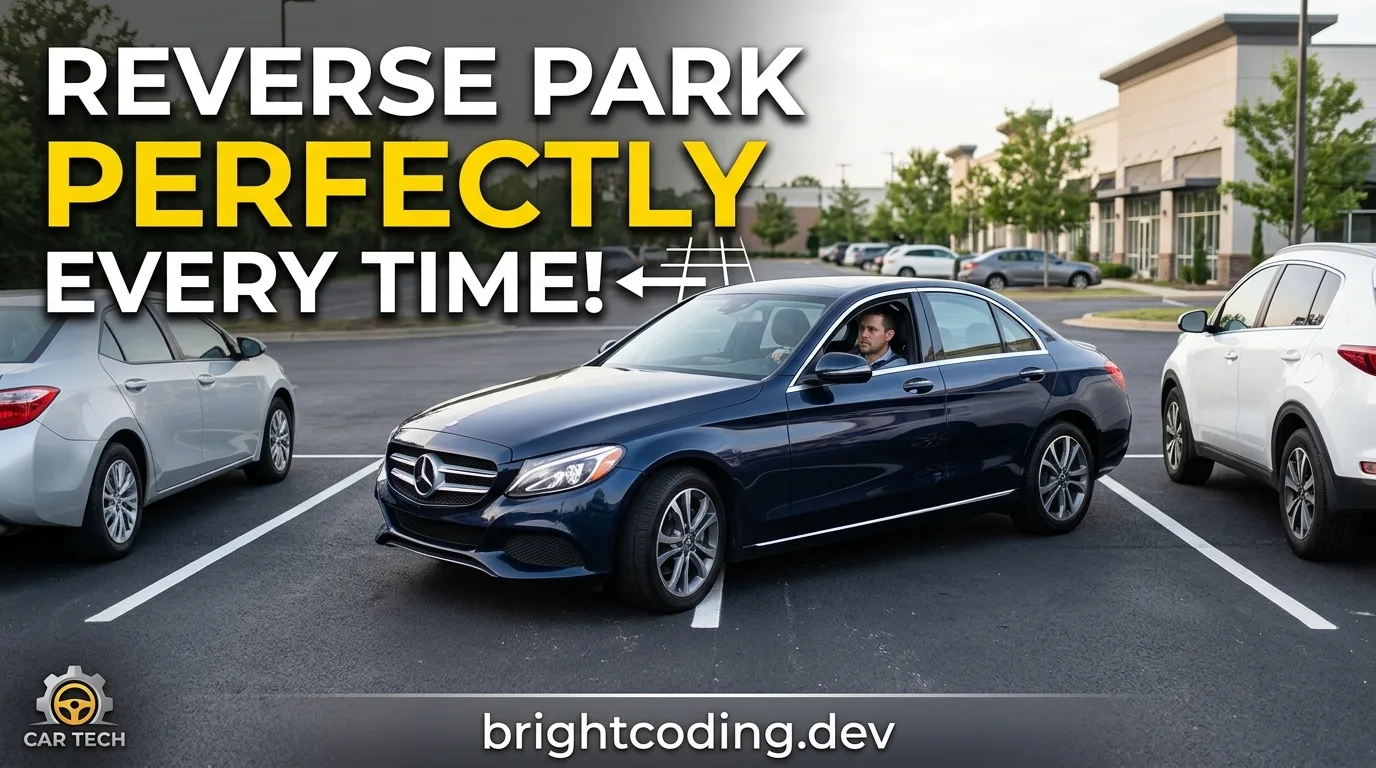
Reverse parking is the one driving skill almost nobody practises after they pass their test. That is why it feels hard. The good news: it is a geometry problem, not a talent contest. Once you know where to put your car and when to turn the wheel, the manoeuvre repeats itself the same way every time.
By the end of this guide you will be able to slot into a bay or a kerbside space without the shuffle-pause-embarrassment routine. Expect to spend 20 to 30 minutes in a quiet car park the first time, then a few short sessions to make it automatic.
What you need before you start
You do not need much, and none of it is expensive.
- Your own car, with mirrors set properly (more on that in step 1).
- A quiet car park with painted bay lines, ideally with a couple of empty bays beside you. Sunday morning at a retail park is perfect.
- Two cones, or two plastic bottles filled with water, if you want to mark a target bay. Chalk works too.
- A phone on a tripod if you want to film yourself. Watching your own steering inputs back is genuinely humbling and genuinely useful.
- A passenger who can stand outside and spot for you. Optional, but a second pair of eyes speeds up the learning curve.
That is it. No special equipment, no gadgets.
Step 1: Set your mirrors before you move an inch
This matters more than any steering trick. If you cannot see your rear wheel and the ground beside it, you are parking blind.
Set the side mirrors so you can just see a sliver of your own car's flank, with the horizon roughly a third down the glass. Then, for parking specifically, tilt the mirror down until you can see the rear wheel arch and the tarmac next to it. Many cars with electric mirrors can save this as a "parking" position, which is worth setting up once.
Why it matters: you judge the whole manoeuvre from the mirrors. A mirror aimed at the sky tells you nothing about the kerb.
Tip: Sit in your normal driving position when you adjust them. Leaning over to check a mirror is a habit that hides mistakes until it is too late.
Step 2: Pick a space you can actually get out of
The best reverse parkers are picky. A space that is tight for the car is also tight for your doors, and getting in is only half the job.
Look for a bay with at least one empty neighbour, or a kerbside gap roughly one and a half car lengths long. If the space is on a busy road, check your local rules first: in many places reverse parking into a kerbside gap is expected, but some roads have specific restrictions. Verify the local signage rather than assuming.
Tip: If you have a choice, always reverse into a bay rather than nose-in. You leave forwards, which is safer in a busy car park where pedestrians and trolleys appear from nowhere.
Step 3: Line up parallel and close
Drive slowly past the space and stop when your car is parallel to the car in front of the bay (or the bay line), with roughly half a metre to a metre of gap between you and it.
For a bay on your right, position your car slightly left of centre in the lane, so you have room to swing the nose out as you reverse. For a bay on your left, mirror that.
Why it matters: this starting position sets up the whole arc. Start too far away and you will not have enough angle. Start too close and you will clip the neighbouring car.
Tip: Half a metre is about the length of a shopping trolley handle to its basket. It feels closer than it is.
Step 4: Reverse slowly, and turn at the right moment
Engage reverse, check all around, and creep back at walking pace. As your rear bumper passes the corner of the car or bay beside you, begin turning the wheel towards the space.
The reference point most drivers use: turn when your rear wheel is level with the far edge of the space you are entering. From there, keep the wheel turned and let the car arc in. If you have a reversing camera or sensors, use them as a guide, not as a substitute for your mirrors.
Why it matters: turning too early swings your nose into the car beside you. Turning too late means you end up too far out and have to start over.
Tip: Keep your foot hovering over the brake and let the car idle backward. Idle speed plus steering is enough. If your car has an automatic parking brake or hill-hold, learn how it behaves in reverse in an empty car park first, because it can grab unexpectedly.
Step 5: Straighten up and check both sides
Once your car is roughly halfway into the space and angled correctly, straighten the wheel and continue reversing until you are centred.
Check both mirrors every couple of seconds. The car that looks "far away" in the left mirror is often much closer on the right. If you are between two cars, watch your door mirrors for clearance on both sides at once.
Why it matters: most scrapes happen in this final metre, not in the big arc.
Tip: If you are unsure, stop, get out and look. There is no prize for guessing. A five-second walk around the back beats a repair bill.
Step 6: Stop at the right depth
Reverse until your rear bumper is a comfortable distance from whatever is behind you. In a bay, that usually means stopping when your mirrors are roughly level with the neighbouring cars' mirrors. At a kerb, stop before the wheels touch.
If you are using sensors, remember they beep continuously at a distance that is often still safe. Do not panic and slam the brakes, but do not ignore the tone either.
Tip: A wall or a low bollard can sit below your rear window line and outside your mirror view. If you cannot see what is behind you, treat it as solid and stop earlier.
Step 7: Secure the car and get out safely
Once parked, apply the parking brake, select park or first gear, and switch off. Before opening your door, check your mirror for cyclists and pedestrians.
If you are on a slope, turn your front wheels towards the kerb (facing downhill) or away from it (facing uphill) as a back-up to the parking brake, and check your owner's manual for the recommended procedure. This is a safety habit, not a superstition.
Tip: If you park in the same bay regularly, note a landmark in your mirror at the moment you stop. Next time, that landmark tells you exactly where to halt.
Pro tips
Use the "one and a half car lengths" rule for kerbside gaps. If the gap is shorter, walk away. A space you squeeze into is a space you will struggle to leave.
Practise with cones, not cars. Set two cones a car width apart and reverse between them twenty times. You will learn your car's turning circle far faster than by hunting for real spaces.
Learn one reference point and stick with it. Every driver has a slightly different landmark, such as a particular pillar on the car beside them or a mark on your own rear quarter. Find yours and use it every single time.
Check your tyre pressures and tread before a long parking-heavy trip. Uneven tyres affect how the car tracks at low speed. If you are comparing wheel and tyre setups for a different car, the tire size comparison tool can help you sanity-check what actually fits.
If a warning light appears while you are manoeuvring, do not ignore it. A quick scan with a free OBD code lookup takes seconds and tells you whether it is something minor or something you should not be driving on.
Watch your steering at full lock. Holding the wheel hard against the stop for long periods is rough on the power steering system. Ease off the lock slightly once you are moving.
Common pitfalls
Turning too early. This is the number one mistake. The nose swings out and clips the car beside you. Fix: wait until your rear wheel is level with the far edge of the space before turning.
Rushing the last metre. Most damage happens at the end, when drivers relax and stop checking mirrors. Fix: keep checking until the car is stationary and the brake is on.
Relying only on the camera. Cameras have blind spots and fisheye distortion. Fix: mirrors first, camera as confirmation.
Ignoring pedestrians and cyclists. In a car park, people walk behind reversing cars constantly. Fix: check all around before you move, and again as you reverse.
Refusing to start over. If the angle is wrong, it is wrong. Fix: pull forward, reset your starting position, and try again. Starting over takes ten seconds. A dent takes weeks to sort out.
If you want to understand what is actually happening mechanically when you turn the wheel, the mechanical encyclopedia is a good place to dig into steering and suspension basics.
Useful resources
- Your owner's manual, especially for parking brake behaviour, wheel angle recommendations on slopes, and any automatic parking features.
- A quiet car park and two cones. Still the best teacher.
- The step-by-step car guides for related maintenance and driving tasks you can do yourself.
- The free car tools for handy calculators and checkers.
- The OBD live-data tool if you want to watch what your car is doing while you drive.
- The AI mechanic assistant for quick questions when something feels off.
- The car symptom finder if a noise or warning light shows up after your practice session.
- The AutoTools blog and expert car tips for more practical advice.
- The mechanic quiz if you want to test how much of this you have actually absorbed.
FAQ
How long does it take to learn reverse parking? Most drivers become consistent after three to five focused practice sessions of 20 to 30 minutes. Some get it in one. It depends on how often you practise, not on natural ability.
Do I need a reversing camera? No. Cameras help, but they are a supplement to mirrors, not a replacement. Learn without relying on one and you will park confidently in any car.
Is it illegal to reverse park on a road? Rules vary by country and sometimes by street. Check your local highway code or driving authority guidance. In many places reverse parking into a kerbside gap is standard practice.
What if I hit something while practising? Stop, secure the car, and check for damage and injuries. If there is any doubt about safety, do not drive on. For mechanical worries afterward, a quick scan with the free OBD code lookup can help you decide your next step.
Should I use automatic parking assist if my car has it? It can be useful, especially in tight bays, but understand that you are still responsible for the manoeuvre. Learn the manual skill first so you are never stuck when the system will not engage.
Final word
Reverse parking is not a test of nerve. It is a repeatable sequence: mirrors set, position right, turn at the right moment, creep back, check, stop. Get those five things in order and the space will not matter. Spend half an hour in an empty car park this week, and the next time you pull up to a tight bay, you will know exactly what to do.
Ready to act on what you just read? Decode that warning light with the free OBD code lookup, run the matching car tools to check the numbers yourself, or browse more practical car articles for ideas.
Related articles

10 Signs Your Petrol or Diesel Engine Is Starting to Fail
Your engine rarely dies without warning. It whispers first, then talks, then screams. Most drivers only start listening at the screaming stage, which is when the repair bill has already tripled.
Read the article →
Petrol vs Diesel: Which Engine Is Cheaper to Maintain?
You are standing in a dealer lot or scrolling through listings, and the same question keeps surfacing: petrol or diesel? The sticker price is only half the story. What you actually pay over five or seven years depends on servicing, parts, fuel, and how the car is driven. That is where the petrol vs…
Read the article →
Petrol vs Diesel Engine: Which One Is Really Better in 2026?
Buying a car in 2026 means you cannot dodge the petrol versus diesel question, especially if you are shopping used or looking at a nearly-new car that still has a combustion engine under the hood. Read this and you will know how to match the engine to your actual driving, work out what the fuel and…
Read the article →
Carburetor vs. Fuel Injection: Which System Is Better?
You already know the short answer: fuel injection wins on paper. It has won in showrooms for decades, and there is no serious argument left about which system meters fuel more precisely. So why does the question still come up in the bay every week?
Read the article →
How to Parallel Park Like a Pro: Simple Tricks That Work
Parallel parking is the one driving skill most people never really learn. They pass the test, then spend the next twenty years circling the block for a spot they can just pull into. That ends today.
Read the article →
Gasoline Fuel Injection Systems Explained: The No-BS Guide to MPI, GDI, PFI, and Everything In Between
Confused by MPI, GDI, PFI, and dual injection? You’re not alone. no-BS guide breaks down every gasoline fuel injection system in plain English how they work, where they spray, and which one is best for your car. Learn real differences, common symptoms, and maintenance tips without textbook jargon.
Read the article →