We Built a Free Mechanic School (No Signup, No $15,000 Course) - Here's How to Actually Learn Car Diagnostics
Most people learn car diagnostics the expensive way: pay for mistakes, or pay for a course. We built a free, interactive academy instead — clickable circuits, virtual scan tools, real diagnostic cases and 360+ questions. Here's the fastest path from zero to 'I actually understand my car.'
Heads up: this is our own platform. It's free, ad-supported, and it costs you nothing. We wrote this because we got tired of watching people pay for guesswork.
Your check engine light doesn't care that you're not a mechanic. Neither does a rough idle, a dead battery on a Monday morning, or an AC that only works on the motorway.
Here's the uncomfortable truth about learning car diagnostics: the information exists, but it's scattered across forums, 12-minute YouTube videos that skip the important part, and courses that cost more than the parts you're trying to fix.
So we built the thing we wished existed — a proper interactive automotive diagnostic academy, and we made it free.
👉 Start learning at AutoTools Academy →
Why "just watch a video" doesn't make you a diagnostician
Watching someone else fix a car is entertainment. Being able to do it yourself is a skill — and skills come from practising, not watching.
That's the whole idea behind the Academy: every concept can be touched.
- A circuit isn't a picture — it's a clickable diagram where every fuse, relay and ground explains its job, its typical value, how to test it and how it fails.
- A sensor isn't a paragraph — it's a waveform you compare in an oscilloscope simulator.
- A fault code isn't a scare — it's a real diagnostic case you solve step by step until you reach the confirmed cause.
That's the difference between knowing about cars and diagnosing them.
What's actually inside (yes, all of it is free)
The Academy is built as six levels, from "what is a car made of" to "how do modern electric vehicles work":
| Level | What you learn |
|---|---|
| 1 · Fundamentals | Engine, drivetrain, braking, steering and suspension, fluids, how it all fits together |
| 2 · Automotive Electricity | Voltage, current, resistance, battery, alternator, fuses, grounds, using a multimeter |
| 3 · Automotive Electronics | Sensors, actuators, ECUs, CAN bus, signals, the oscilloscope |
| 4 · Diagnostics | OBD-II, trouble codes, freeze frame, live data, professional methodology |
| 5 · Advanced Diagnostics | Injection, turbo, EGR, DPF, ABS, airbag, air conditioning, automatic gearboxes, intermittent faults |
| 6 · Modern Vehicles | Hybrids, EVs, high-voltage safety, BMS, inverters, ADAS, coding and programming |
And because we hate dead-end "courses", the numbers are real and growing:
- 75 modules and 100+ lessons
- 360+ quiz questions with explanations (and level exams)
- 29 interactive diagrams you can click, zoom and animate
- 18 diagnostic trees that walk you from a symptom to a likely cause
- 26 hands-on exercises and 16 real diagnostic cases
- Simulators: multimeter, oscilloscope, OBD-II scanner and AC pressures
The 10-minute taste test: learn the four-stroke cycle the right way
Don't take a tour of features. Try one lesson and feel the difference.
The Four-Stroke Cycle lesson does what a good instructor does:
- Explains intake, compression, power and exhaust — with a table, not a wall of text.
- Shows you an interactive engine diagram where the piston actually moves.
- Gives you a drag-and-drop exercise to put the strokes in order.
- Quizzes you on it immediately.
- Warns you about the real-world trap (a skipped timing belt on an interference engine = bent valves).
Ten minutes in, you understand something most drivers never will.
Learn the two tools that change everything
If you want a shortcut to real diagnostic confidence, learn these two first:
🔌 The multimeter
The Using a Multimeter module teaches voltage, resistance and continuity — then puts a virtual multimeter in your hands. You pick the function, choose the probe points, and read both the measurement and what it means.
Pair it with the battery module and you'll never be fooled by "your battery is dead" again — you'll know how to check open-circuit voltage, cranking voltage and the charging system.
📈 The oscilloscope
Signals are where modern diagnostics lives. The oscilloscope module shows you how to set time/div, volts/div and the trigger, then lets you compare normal vs faulty waveforms for crank sensors, injectors, ignition and CAN.
That's the moment most people go from "I replace parts" to "I measure things."
Then practise like it's the real job
Theory gets you reading. Cases get you thinking.
Each diagnostic case is a virtual vehicle with a complaint, a history, codes, live data and a guided path:
- A customer says the AC is cold on the motorway but warm in traffic. → Solve the AC case →
- A battery keeps going flat, twice replaced. → Battery discharge case →
You choose the next test, get told why it's right or wrong, and only then see the confirmed cause and the reasoning. That's how diagnostic instincts are built.
Stuck on a symptom with no idea where to start? The diagnostic trees work like a mechanic's brain: question → test → result → next question → probable cause.
The circle we care about most: course → tool → result
This is the part we're proudest of. The Academy doesn't live in a bubble — it connects straight to the tools people actually use:
- Learning battery diagnosis? Open the Battery Calculator and check your own car.
- Studying charging systems? Run the Charging System Check.
- Reading OBD-II? Look up the exact code on your car.
- Doing AC work? Use the AC Diagnostic tool and the new AC pressure simulator.
Learn it, then measure it on your own car. That loop is where confidence is made.
How to actually use this (a 30-day plan that works)
Don't binge. Build a habit.
Week 1 — Fundamentals. Do Level 1. Watch the animated four-stroke diagram, pass the quizzes, learn the vocabulary. → Start with Fundamentals →
Week 2 — Electricity. This is the highest-leverage week of your life as a diagnostician. Multimeter, battery, charging, grounds. → Jump into Automotive Electricity →
Week 3 — Electronics. Sensors, actuators, CAN, and the oscilloscope. Slow down here; it's worth it. → Explore Electronics →
Week 4 — Diagnostics + cases. OBD-II, freeze frame, live data — then solve cases until you stop guessing. → Go to Diagnostics →
Track everything on the My Learning dashboard. It saves your progress on your device (no account required), and if you're signed in, it syncs.
Built for real life: phone-first, offline, and in your language
- No signup, ever. Progress is stored locally with
localStorageand synced only if you want it to be. - Works on your phone and installs as a PWA — so lessons and diagrams are there when your hands are dirty and the signal isn't.
- 🇬🇧 English, 🇫🇷 French and 🇸🇦 Arabic — the full course, not just the menus (including RTL).
- Safety first. High-voltage, airbag, programming and refrigerant topics come with clear warnings and are framed as advanced, manufacturer-dependent work. We teach you to respect the systems, not to cowboy them.
The honest part
The Academy teaches real, technician-grade content: how to measure voltage drop, how to read fuel trims, how to prove a boost leak before replacing a turbo. But it will never tell you a single number is "universal" — because real values depend on the manufacturer, the engine, the temperature and the system. Every lesson says typical value, confirm with the vehicle documentation.
That's not a weakness. That's the difference between training and marketing.
❓ Quick FAQ
Is it really free? Yes. No account, no paywall. The site runs on non-intrusive ads.
Do I need a car or tools to start? No. The simulators (multimeter, oscilloscope, OBD, AC) let you practise before you own anything.
I'm a total beginner. Is it too advanced? No. Start at Level 1 and follow the levels in order. It's designed to walk you up, not throw you in.
Does it work offline? Yes — install it as a PWA and your visited lessons, diagrams and progress stay available.
Is it in other languages? Yes: English, French and Arabic, with the course content translated.
🎯 Your move
You can keep paying for diagnostics you don't understand, or you can spend 10 minutes today and change how you look at your car.
Free. No signup. Interactive. Weirdly addictive.
👉 Start the AutoTools Academy now →
Then come back and tell us which case you solved first.
AutoTools is a free, no-signup toolbox — 45+ calculators, an OBD-II code database, guides and this Academy. It's ad-supported so it can stay free for everyone.
Related articles

10 Signs Your Petrol or Diesel Engine Is Starting to Fail
Your engine rarely dies without warning. It whispers first, then talks, then screams. Most drivers only start listening at the screaming stage, which is when the repair bill has already tripled.
Read the article →
10 Gasoline Engine Maintenance Tips to Make Your Car Last Longer
Your engine doesn't die suddenly. It dies by a thousand small neglects, most of them cheap to fix and easy to postpone. This is the short list of habits that quietly add years to a gasoline engine, and the mistakes that quietly take them away.
Read the article →
Petrol vs Diesel: Which Engine Is Cheaper to Maintain?
You are standing in a dealer lot or scrolling through listings, and the same question keeps surfacing: petrol or diesel? The sticker price is only half the story. What you actually pay over five or seven years depends on servicing, parts, fuel, and how the car is driven. That is where the petrol vs…
Read the article →
Petrol vs Diesel Engine: Which One Is Really Better in 2026?
Buying a car in 2026 means you cannot dodge the petrol versus diesel question, especially if you are shopping used or looking at a nearly-new car that still has a combustion engine under the hood. Read this and you will know how to match the engine to your actual driving, work out what the fuel and…
Read the article →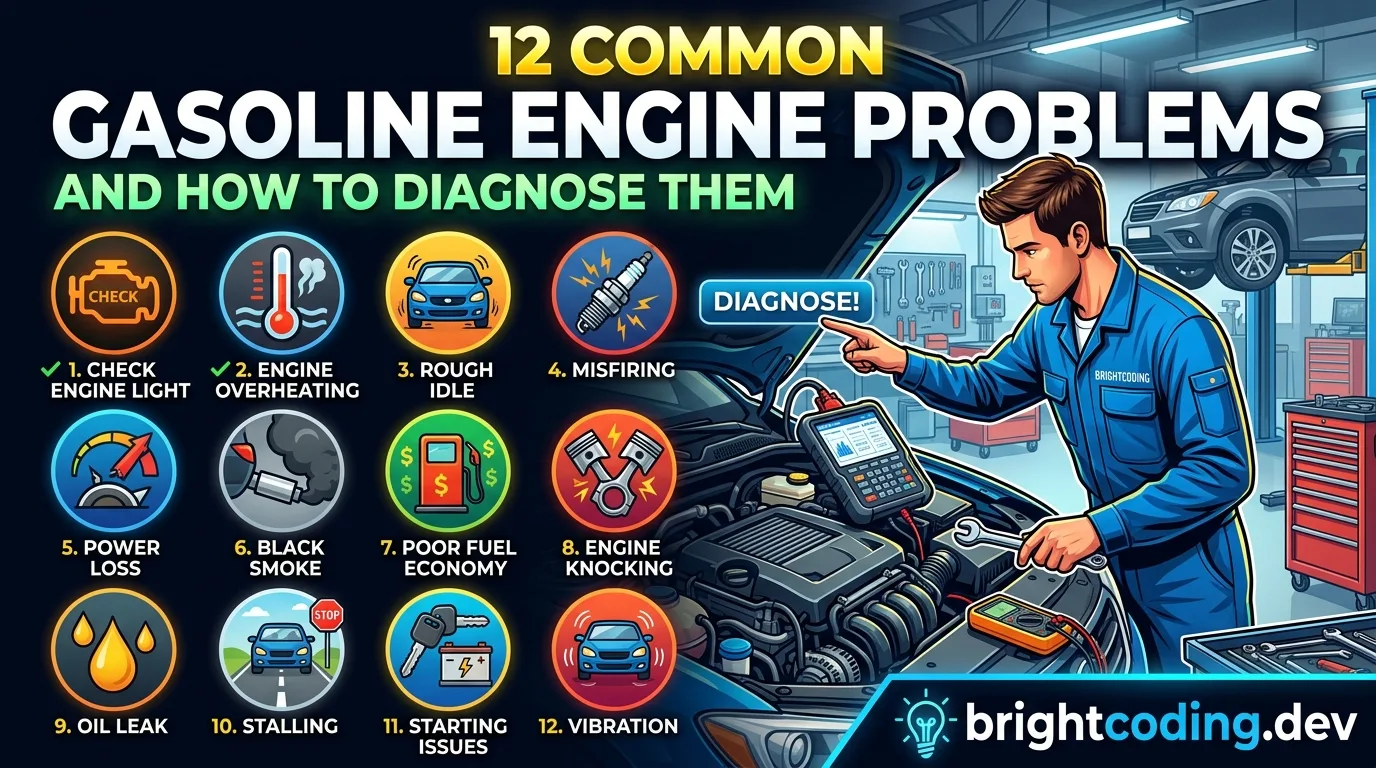
12 Common Gasoline Engine Problems and How to Diagnose Them
Your check engine light comes on. The engine starts shaking at a red light. You hear a noise that wasn't there last week. Most people do one of two things: panic and hand the car to a shop with a blank check, or ignore it until the problem gets expensive.
Read the article →
Carburetor vs. Fuel Injection: Which System Is Better?
You already know the short answer: fuel injection wins on paper. It has won in showrooms for decades, and there is no serious argument left about which system meters fuel more precisely. So why does the question still come up in the bay every week?
Read the article →