Understanding Gasoline Engine Combustion and Air-Fuel Ratio
Your check engine light came on, the car feels gutless, and someone told you it's "running lean." Or maybe you're just curious why your fuel economy dropped two miles per gallon this month. Either way, you've landed on the right question: how does gasoline actually burn inside your engine, and what…
Your check engine light came on, the car feels gutless, and someone told you it's "running lean." Or maybe you're just curious why your fuel economy dropped two miles per gallon this month. Either way, you've landed on the right question: how does gasoline actually burn inside your engine, and what does the air-fuel ratio have to do with any of it?
Here's the short version. Your engine is an air pump that burns fuel, and it only runs well when those two ingredients arrive in roughly the right proportions. Get that ratio wrong and you get poor power, bad mileage, a rough idle, or worse. Understand the ratio, and a lot of confusing symptoms suddenly make sense.
What Actually Happens Inside the Cylinder
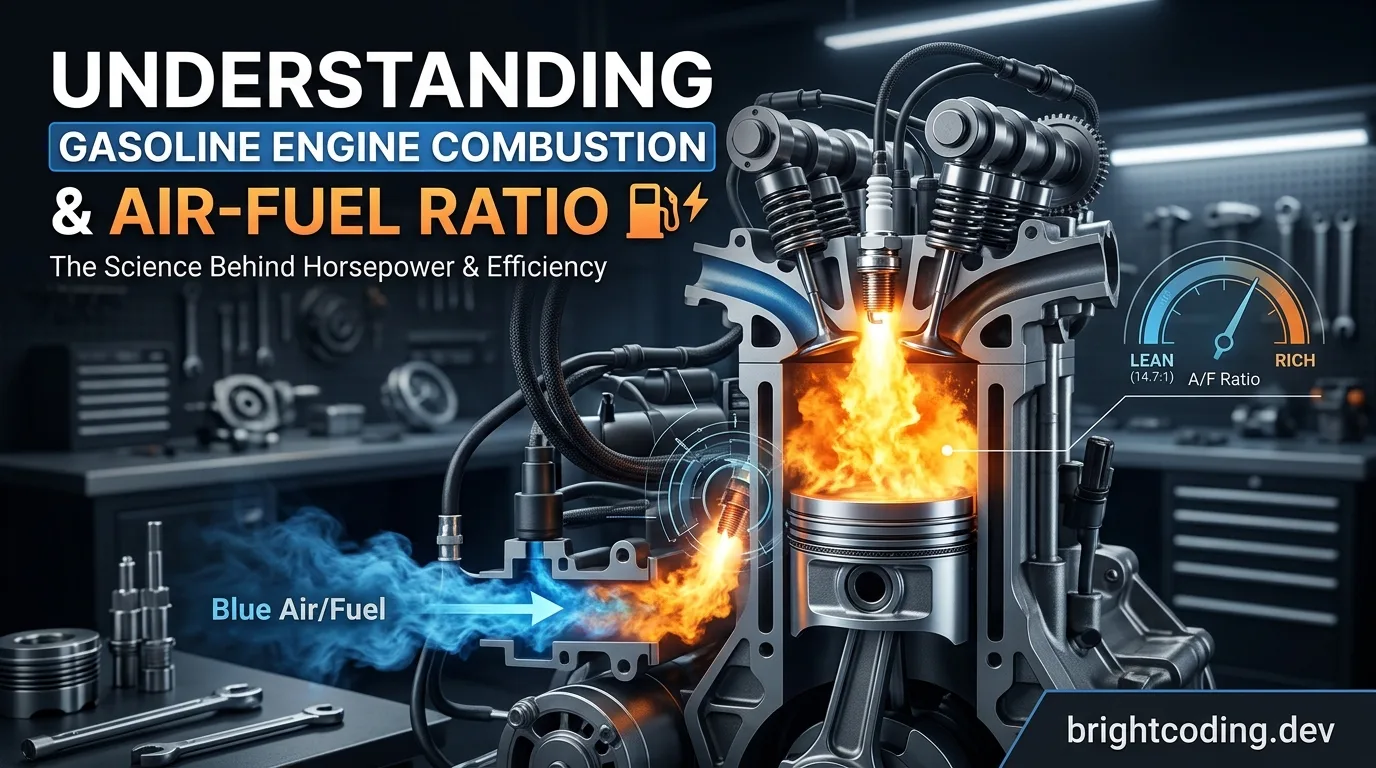
Combustion isn't an explosion, despite what movies suggest. It's a fast, controlled burn. The piston squeezes a mixture of air and vaporized gasoline, the spark plug ignites it, and the expanding gases push the piston down. That push is your power.
Air is the part people underestimate. Gasoline needs oxygen to burn, and air is where the oxygen comes from. About 14.7 grams of air to 1 gram of gasoline is the chemically "perfect" mix, called the stoichiometric ratio. At that ratio, in theory, all the fuel and all the oxygen cancel each other out.
Real engines rarely sit exactly there. They swing rich (too much fuel) or lean (too little) depending on load, temperature, and what the computer is trying to do.
Why the Ratio Matters More Than You Think
The air-fuel ratio decides three things at once: power, efficiency, and emissions. You can't max out all three at the same time, which is why engine computers are constantly adjusting.
Run rich and you get more power and cooler combustion, but you burn extra fuel and clog your catalytic converter over time. Run lean and you get better economy and lower emissions, until you go too far and combustion gets hot enough to damage pistons and valves.
That's the whole tension. Every symptom you've ever blamed on a "bad engine" often traces back to this balance being off.
The Parts That Keep the Ratio in Check
You don't manage the air-fuel ratio by hand. A few components do it for you, and when one fails, the ratio drifts.
The mass air flow sensor measures how much air is entering. The oxygen sensors (O2 sensors) measure what's left in the exhaust after combustion. The engine control unit reads both and adjusts fuel injector pulse width, meaning how long each injector stays open. Longer pulse, more fuel. Shorter pulse, less.
Throw in the throttle body, fuel pressure regulator, and intake system, and you have a chain of parts where one weak link throws off the whole mixture. This is why a dirty MAF sensor can feel exactly like a failing fuel pump to a driver.
If you want to see these parts in context, the mechanical encyclopedia breaks down how each one fits into the system.
What Lean and Rich Actually Feel Like
This is the part that saves you money at the shop.
A lean condition usually shows up as a rough idle, hesitation when you accelerate, and sometimes a pinging or knocking sound. A rich condition often means black smoke from the tailpipe, a strong gasoline smell, fouled spark plugs, and terrible fuel economy.
Neither one is subtle once you know what to look for. If your car feels fine but the light is on, don't panic, but don't ignore it for months either. Catalytic converters are expensive, and running rich is a common way to kill one.
Reading the Codes and Data
Here's where a scan tool earns its keep. Codes like P0171 (system too lean, bank 1) or P0174 (bank 1 lean, other bank) point you straight at the mixture problem. You can decode them with a free OBD code lookup, and that's usually the fastest way to stop guessing.
Codes tell you what the computer noticed. Live data tells you why. Watching short-term and long-term fuel trims on a live-data tool shows whether the engine is adding fuel or pulling it back, and by how much. A long-term trim of plus 20 percent is the engine screaming that it's starving for fuel or gulping unmetered air.
That single number often separates a five-minute fix from a weekend of parts swapping.
The Solutions, Ranked by Realism
Start with the cheap diagnosis. Clean the mass air flow sensor with the proper spray, check for vacuum leaks with a smoke test or a careful listen, and inspect intake boots for cracks. This costs you almost nothing and catches a surprising number of lean codes.
Replace the obvious wear items. O2 sensors and spark plugs have service lives. If your car is past 100,000 miles and running rich, an aging upstream O2 sensor is a prime suspect. Parts run roughly $40 to $150 each depending on the car, and labor varies widely.
Check fuel delivery. A weak fuel pump or clogged filter causes lean conditions under load. Testing fuel pressure tells you the truth instead of replacing parts on a hunch.
Get a proper diagnosis if you're stuck. A shop with a scan tool and smoke machine can find an intermittent vacuum leak in twenty minutes that you'd chase for a week. Expect to pay for an hour of diagnostic time, often $100 to $200 depending on your area.
Consider a professional tune or reflash only if it fits. Some cars benefit from updated software, but this is not a DIY fix and rarely the answer to a plain mixture problem.
Which Path Fits You?
If you're a hands-on owner with a basic scan tool, start with the free checks: clean the MAF, hunt vacuum leaks, read your fuel trims. You'll solve most lean codes yourself.
If you're a busy commuter with no interest in wrenching, a single diagnostic visit is money well spent. Pay for the diagnosis, get the real cause, then decide whether to fix it yourself.
If you're already deep in a parts-swapping spiral, stop. Pull the live data, look at the trims, and let the numbers point you to the system instead of the part. The AI mechanic assistant can help you interpret a confusing set of readings before you spend another dollar.
Step-by-Step Action Plan
- Pull the codes. Write them down before clearing anything. Use the OBD code lookup to understand what each one means.
- Look at freeze-frame and live data. Note fuel trims at idle and at cruise. They often differ, and that difference is a clue.
- Inspect for vacuum leaks. Check intake hoses, the PCV system, and the intake manifold gasket area. Listen for a hiss at idle.
- Clean the MAF sensor. Use only MAF cleaner, never brake cleaner, and let it dry fully before reinstalling.
- Test fuel pressure if trims suggest a fuel shortage.
- Replace worn sensors and plugs based on mileage and symptoms, not guesswork.
- Recheck trims after each change. One fix at a time, so you know what actually worked.
Safety note: disconnect the battery negative terminal before working near wiring, never open the fuel system on a hot engine, and if you lift the car, use jack stands, not just a jack.
Common Mistakes to Avoid
Clearing codes before writing them down. You lose the history that points to the cause. Read first, clear later.
Replacing the O2 sensor when the real problem is a vacuum leak. The sensor is reporting a symptom, not causing it. Fix the leak first.
Using the wrong cleaner on the MAF sensor. It leaves residue and can ruin the sensor. Use the correct spray.
Assuming a lean code means a bad fuel pump. Sometimes it's a $5 vacuum hose. Test before you buy.
Ignoring a rich condition until the catalytic converter dies. Rich running cooks cats. Deal with it early.
Tuning or modifying before the engine runs right. You can't tune around a mechanical fault.
Expert Takeaway
The air-fuel ratio is the language your engine uses to tell you what's wrong. Learn to read fuel trims and codes, and you stop guessing. Most mixture problems come down to unmetered air, weak fuel delivery, or a tired sensor, and a scan tool plus a careful inspection finds the culprit faster than any parts cannon ever will. For a broader walkthrough of diagnostics, the step-by-step car guides are worth bookmarking.
FAQ
What is the ideal air-fuel ratio for a gasoline engine? About 14.7 to 1 by weight is the chemically perfect ratio, but real engines vary it constantly for power, efficiency, and emissions. Your owner's manual won't list a single number because there isn't one.
What happens if the air-fuel mixture is too lean? Combustion runs hotter and can cause hesitation, knocking, and in severe cases piston or valve damage. It also triggers codes like P0171.
What happens if it's too rich? You lose fuel economy, foul spark plugs, and risk damaging the catalytic converter over time. Black smoke and a gasoline smell are common signs.
Can I fix an air-fuel ratio problem myself? Often yes. Cleaning the MAF sensor, finding vacuum leaks, and replacing worn O2 sensors or plugs are realistic DIY jobs. If trims stay off after that, get a professional diagnosis.
How much does it cost to fix a lean condition? It ranges from nearly free (a vacuum hose) to several hundred dollars (fuel pump or O2 sensors), plus diagnostic time. Get the cause confirmed before approving any repair.
Ready to act on what you just read? Decode that warning light with the free OBD code lookup, run the matching car tools to check the numbers yourself, or browse more practical car articles for ideas.
Related articles

10 Signs Your Petrol or Diesel Engine Is Starting to Fail
Your engine rarely dies without warning. It whispers first, then talks, then screams. Most drivers only start listening at the screaming stage, which is when the repair bill has already tripled.
Read the article →
Petrol vs Diesel: Which Engine Is Cheaper to Maintain?
You are standing in a dealer lot or scrolling through listings, and the same question keeps surfacing: petrol or diesel? The sticker price is only half the story. What you actually pay over five or seven years depends on servicing, parts, fuel, and how the car is driven. That is where the petrol vs…
Read the article →
Petrol vs Diesel Engine: Which One Is Really Better in 2026?
Buying a car in 2026 means you cannot dodge the petrol versus diesel question, especially if you are shopping used or looking at a nearly-new car that still has a combustion engine under the hood. Read this and you will know how to match the engine to your actual driving, work out what the fuel and…
Read the article →
Carburetor vs. Fuel Injection: Which System Is Better?
You already know the short answer: fuel injection wins on paper. It has won in showrooms for decades, and there is no serious argument left about which system meters fuel more precisely. So why does the question still come up in the bay every week?
Read the article →
How to Parallel Park Like a Pro: Simple Tricks That Work
Parallel parking is the one driving skill most people never really learn. They pass the test, then spend the next twenty years circling the block for a spot they can just pull into. That ends today.
Read the article →
Gasoline Fuel Injection Systems Explained: The No-BS Guide to MPI, GDI, PFI, and Everything In Between
Confused by MPI, GDI, PFI, and dual injection? You’re not alone. no-BS guide breaks down every gasoline fuel injection system in plain English how they work, where they spray, and which one is best for your car. Learn real differences, common symptoms, and maintenance tips without textbook jargon.
Read the article →