How to Choose Automotive Tools: Sizes, Types, Uses & Buying Tips
You can walk into any parts store, look at three shelves of chrome, and still have no idea what you actually need. That is normal. Most tool advice either assumes you already own a shop or sells you a 300-piece kit you will use twice.
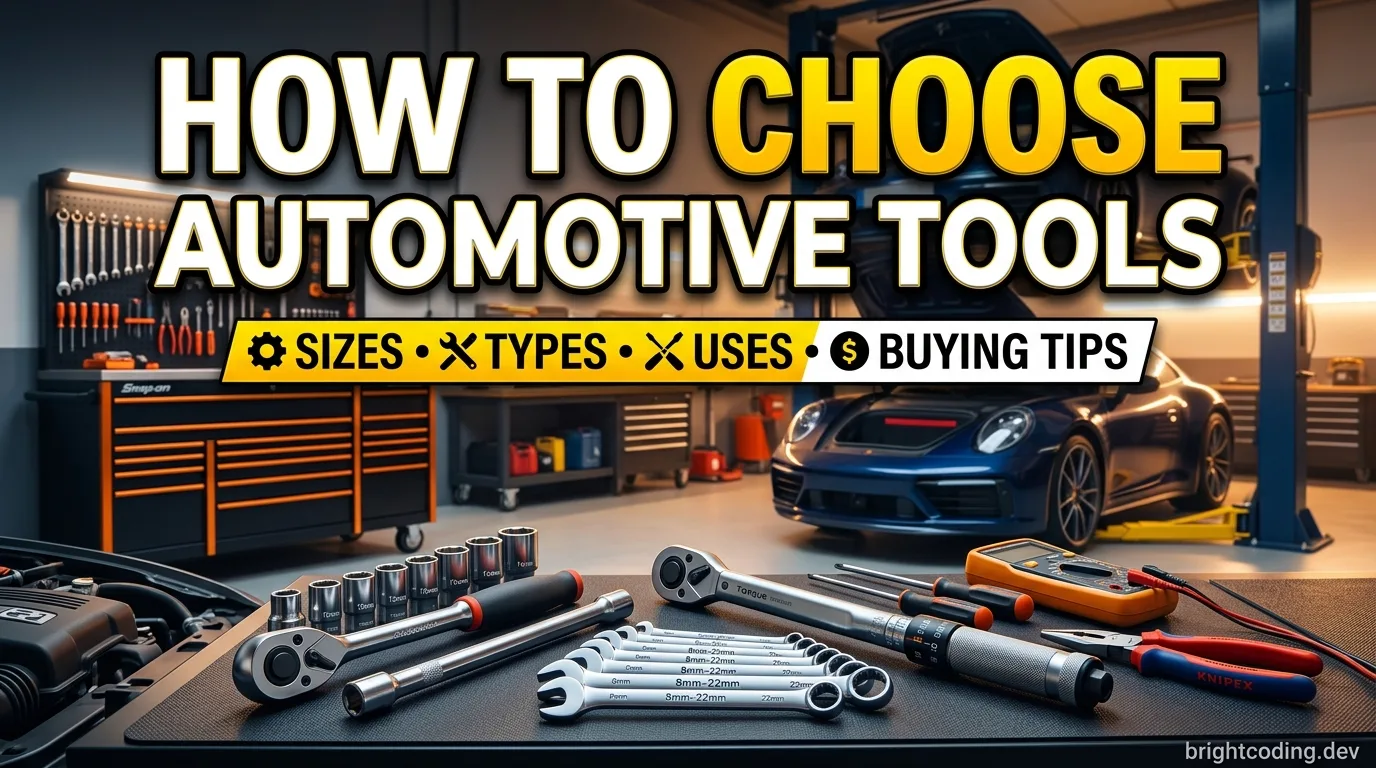
You can walk into any parts store, look at three shelves of chrome, and still have no idea what you actually need. That is normal. Most tool advice either assumes you already own a shop or sells you a 300-piece kit you will use twice.
By the end of this guide you will know how to build a tool set that fits your car, your skill level, and your budget, and you will know which sizes and types matter most. Reading time is about 10 minutes. Putting your first sensible kit together takes an afternoon.
What you need before you start
You do not need everything. You need a starting point.
- Your owner's manual (it lists fluid types, jack points, and sometimes lug nut size)
- A tape measure or caliper for measuring fasteners
- A notepad or phone for writing down socket sizes as you find them
- A budget figure in your head, even a rough one
- A clean, flat, well-lit place to work
- Safety glasses and gloves
That is it. No shopping yet.
Step 1: Know what your car actually uses
Metric or imperial? This single question decides half your purchases. Most cars built for Europe and Asia use metric fasteners. Many older American vehicles and some trucks use imperial. Modern cars are usually metric regardless of brand, but verify rather than assume.
Open the hood and look at the bolts holding the plastic covers, the battery terminals, and the hose clamps. If the heads look like 10mm, 13mm, or 17mm, you are in metric territory. If they measure in fractions of an inch, you are in imperial.
Why it matters: Buying a full imperial set for a metric car wastes money and shelf space.
Practical tip: Write down the sizes you find. After a few weekends you will notice your car keeps using the same handful of sizes, and those are the ones worth buying in good quality.
Step 2: Choose your drive size before your socket count
Sockets come in drive sizes, which is the square hole where the ratchet plugs in. Common ones are 1/4 inch, 3/8 inch, and 1/2 inch.
- 1/4 inch drive: small fasteners, interior trim, tight spaces. Low torque.
- 3/8 inch drive: the workhorse. Most under-hood and under-car jobs.
- 1/2 inch drive: suspension, lug nuts, anything stubborn.
If you buy one ratchet set, buy 3/8 inch. It covers the widest range of real jobs without being too bulky.
Why it matters: Using a tiny ratchet on a rusted suspension bolt breaks tools. Using a giant one on a 10mm bolt strips threads.
Practical tip: A breaker bar in 1/2 inch drive is one of the best cheap purchases you can make. It saves your ratchet mechanism when something refuses to move.
Step 3: Pick the core hand tools
Here is the short list that handles most DIY work.
- Socket set in your car's measurement system, 3/8 inch drive to start
- Combination wrenches (open end and box end) in your common sizes
- A ratchet and at least one extension bar
- Screwdrivers: Phillips and flathead, several sizes
- Pliers: standard, needle-nose, and locking pliers
- A pry bar or trim removal tools
- A torque wrench
That torque wrench deserves a sentence of its own. Some fasteners must be tightened to a specific value, and guessing is how parts fail. Buy one that covers the range your manual specifies, and check the manual for every critical fastener.
Approximate cost: A reasonable starter set of the above runs from about $80 to $250 depending on brand and country. You can spend far more, and you do not need to at this stage.
Safety note: Never use a torque wrench as a breaker bar. You will ruin its calibration.
Step 4: Add the measuring and diagnostic tools
Tools are not only things that turn bolts. Some of the most useful ones tell you what is wrong.
A basic code reader lets you pull diagnostic trouble codes when the check engine light comes on. Once you have a code, you can run it through the free OBD code lookup at /obd and get a plain-English starting point instead of guessing. If you want to go deeper, an OBD live-data tool at /tools/obd-live-data shows sensor readings in real time, which is how you catch problems codes alone will miss.
Add these over time:
- Tire pressure gauge
- Digital multimeter (for battery and electrical checks)
- A good flashlight or headlamp
Why it matters: Diagnosis tools stop you from replacing parts at random. That saves more money than any discount on sockets.
Practical tip: If a code or symptom has you stuck, describe it to the AI mechanic assistant at /tools/ai-assistant and treat its answer as a starting point, not gospel. Verify anything safety-critical with a shop.
Step 5: Match tools to the jobs you will actually do
Think about the next three jobs on your list, not every job you might ever do.
| Job | Tools you need |
|---|---|
| Oil change | Socket set, drain pan, funnel, filter wrench |
| Brake pads | Socket set, C-clamp or caliper tool, torque wrench |
| Battery swap | Wrench set, wire brush, safety glasses |
| Tire rotation | Jack, jack stands, lug wrench, torque wrench |
Safety note on brakes: Brake work is not a good first job unsupervised. If you are unsure, get help. Brakes are the one system where a mistake hurts someone.
Safety note on batteries: Disconnect the negative terminal first and reconnect it last. Batteries vent hydrogen, so keep sparks and flames away.
Step 6: Decide where to save and where to spend
You do not need top-tier everything. You do need some things to be good.
Spend on: torque wrench, jack stands, breaker bar, ratchets, anything that holds your car up or measures precisely.
Save on: sockets you rarely use, duplicate sizes, organizer trays, and kits padded with 40 bits you will never touch.
Why it matters: Cheap jack stands are a false economy measured in hospital visits. Cheap sockets for a size you use twice a year are fine.
Practical tip: Buy individual sockets to fill gaps rather than replacing an entire set. Most stores sell singles.
Safety note on jacking: Never work under a car held up only by a jack. Use jack stands on a hard, level surface, and chock the wheels. This is not optional.
Step 7: Build slowly and track what you use
The best tool set is the one shaped by your own repair history.
Keep a list on your phone. Every time you borrow a tool or improvise with the wrong one, write it down. After six months that list tells you exactly what to buy next, and it will look nothing like the generic "must-have" lists online.
Practical tip: When you are unsure how a system works, the mechanical encyclopedia at /encyclopedia is a good place to get oriented before you start turning bolts.
Pro tips
- Buy 6-point sockets for tough bolts, 12-point for speed. Six-point grips more of the fastener head and is less likely to round it off.
- Keep a "sacrificial" cheap wrench you can cut or bend. Sometimes the right tool does not exist and you make one.
- Photograph everything before you take it apart. Reassembly is easier with pictures than with memory.
- Label bolts in sandwich bags as you remove them. Future you will be grateful.
- A magnetic tray costs almost nothing and saves hours. Dropped bolts in gravel are a special kind of frustration.
- Check the step-by-step car guides at /guides before a new job. Seeing the sequence once saves mistakes.
Common pitfalls
Buying a giant kit for the piece count. Most of those pieces are duplicates and filler. A focused 60-piece set beats a padded 300-piece one.
Skipping the torque wrench. "Tight enough" is how you strip an oil pan drain plug or warp a brake rotor.
Using the wrong drive size on a stuck bolt. You will break the tool or round the fastener. Step up to a bigger drive and a breaker bar.
Buying cheap safety gear. Jack stands and gloves are not where you economize.
Assuming all cars are metric or all are imperial. Check yours. This is the mistake that sends people back to the store mid-job.
Useful resources
- Your owner's manual, always the first reference
- The free OBD code lookup at /obd for check engine codes
- The free car tools at /tools for quick calculations and checks
- The car symptom finder at /symptom when you know something is wrong but not what
- The tire size comparison tool at /tires if you are changing wheels or tires
- The AutoTools blog at /blog for ongoing guides and tips
- Expert car tips at /tips for shortcuts worth knowing
- The mechanic quiz at /quiz if you want to test your knowledge before a big job
FAQ
Do I really need a torque wrench? For brakes, suspension, and engine fasteners, yes. For interior trim and plastic covers, not so much. Buy one that covers the range your manual lists.
Metric or imperial for my car? Check the fasteners. Most modern cars are metric. Older American vehicles are often imperial. Do not guess.
What is the single most useful first purchase? A 3/8 inch drive socket set in the correct measurement system, plus a breaker bar. That combination covers a surprising amount of work.
How much should I spend to start? Somewhere between about $80 and $250 gets you a solid starter setup. Spend more on safety gear and measuring tools, less on filler.
Can I do my own brakes? Many people can, with the right tools and patience. It is also one of the jobs where a mistake is dangerous. If you are unsure, watch a full guide first and consider having a shop check your work.
One last thing
You do not need a perfect tool collection. You need a small, sensible one that grows as you learn. Start with the core hand tools, add diagnosis tools as problems come up, and buy quality where it matters. Every good mechanic started exactly where you are, with one ratchet and a lot of questions.
Ready to act on what you just read? Decode that warning light with the free OBD code lookup, run the matching car tools to check the numbers yourself, or browse more practical car articles for ideas.
Related articles

10 Signs Your Petrol or Diesel Engine Is Starting to Fail
Your engine rarely dies without warning. It whispers first, then talks, then screams. Most drivers only start listening at the screaming stage, which is when the repair bill has already tripled.
Read the article →
Petrol vs Diesel: Which Engine Is Cheaper to Maintain?
You are standing in a dealer lot or scrolling through listings, and the same question keeps surfacing: petrol or diesel? The sticker price is only half the story. What you actually pay over five or seven years depends on servicing, parts, fuel, and how the car is driven. That is where the petrol vs…
Read the article →
Petrol vs Diesel Engine: Which One Is Really Better in 2026?
Buying a car in 2026 means you cannot dodge the petrol versus diesel question, especially if you are shopping used or looking at a nearly-new car that still has a combustion engine under the hood. Read this and you will know how to match the engine to your actual driving, work out what the fuel and…
Read the article →
Carburetor vs. Fuel Injection: Which System Is Better?
You already know the short answer: fuel injection wins on paper. It has won in showrooms for decades, and there is no serious argument left about which system meters fuel more precisely. So why does the question still come up in the bay every week?
Read the article →
How to Parallel Park Like a Pro: Simple Tricks That Work
Parallel parking is the one driving skill most people never really learn. They pass the test, then spend the next twenty years circling the block for a spot they can just pull into. That ends today.
Read the article →
Gasoline Fuel Injection Systems Explained: The No-BS Guide to MPI, GDI, PFI, and Everything In Between
Confused by MPI, GDI, PFI, and dual injection? You’re not alone. no-BS guide breaks down every gasoline fuel injection system in plain English how they work, where they spray, and which one is best for your car. Learn real differences, common symptoms, and maintenance tips without textbook jargon.
Read the article →