25 Essential Automotive Tools Every Mechanic Should Have in Their Garage
If you have ever stared at a job and realized you were missing one stupid socket, this list is for you. Below are the 25 tools that cover the vast majority of home garage work, from oil changes to brakes to chasing a check-engine light, plus straight answers on what to buy first, what you can borro…
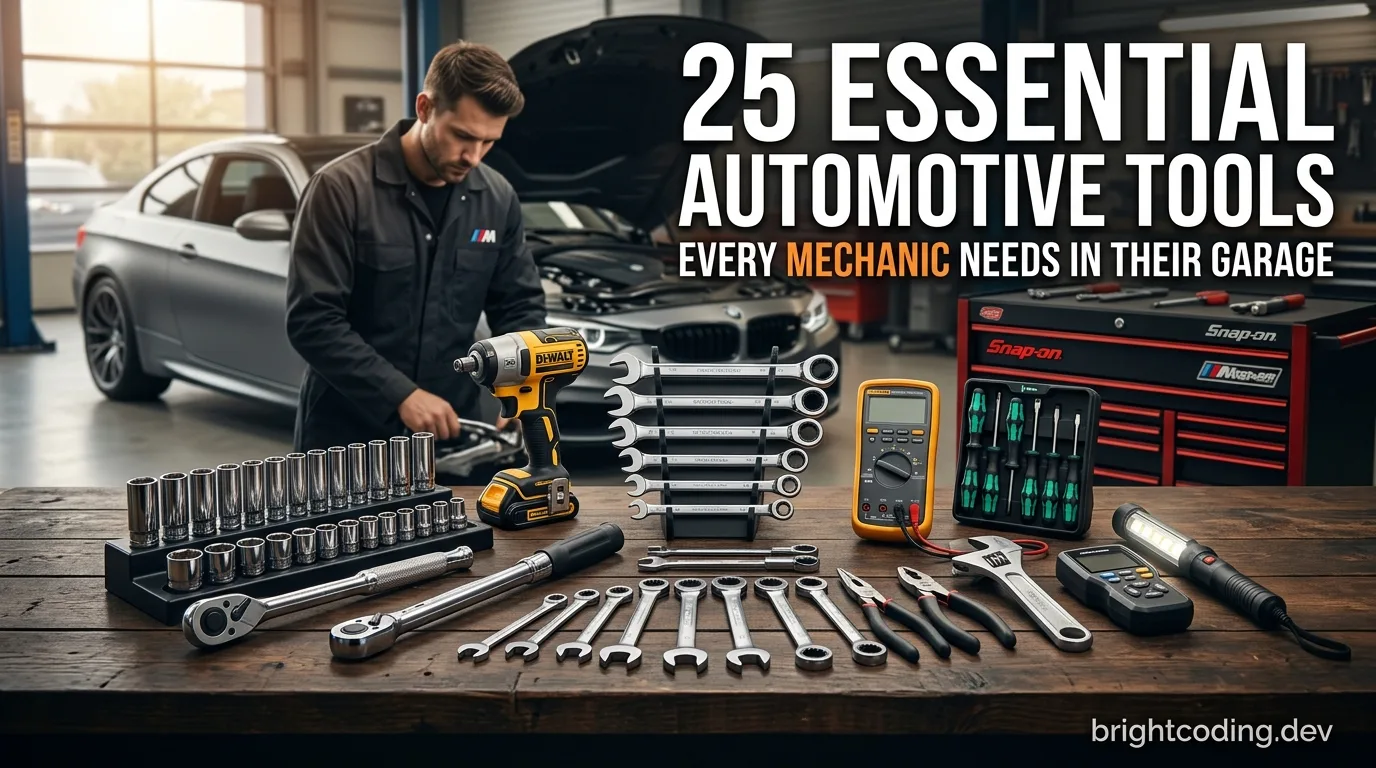
If you have ever stared at a job and realized you were missing one stupid socket, this list is for you. Below are the 25 tools that cover the vast majority of home garage work, from oil changes to brakes to chasing a check-engine light, plus straight answers on what to buy first, what you can borrow, and where cheap tools actually cost you money.
Quick answers
- What tools does every mechanic need first? A ratchet and socket set, a good floor jack with jack stands, a torque wrench, screwdrivers, pliers, and a basic diagnostic scanner. That combination handles most routine maintenance.
- What is the single most important tool in a garage? Jack stands. A jack lifts the car, but only stands make it safe to put your hands underneath.
- Can I do my own car maintenance without a lift? Yes. A floor jack, four stands, and a creeper let you do brakes, oil, suspension, and most under-car work at home.
- Do I need an expensive scan tool? No. A basic OBD2 reader solves most check-engine situations; live-data and bidirectional tools matter more if you plan to diagnose rather than just read codes.
- How much does a starter garage tool kit cost? Expect roughly $300 to $800 for a genuinely usable setup if you buy carefully, though pro-grade versions run into thousands.
What tools should you actually buy first?
Start with the stuff that makes the car safe to work on, then the stuff that makes it easy. A jack and stands come before anything shiny. After that, a 3/8-inch ratchet and socket set in metric covers most modern cars, and a 1/2-inch set handles the stubborn stuff.
Buy the best torque wrench and jack stands you can afford. Cheap out on a socket and you round a bolt head at 9 pm on a Sunday. Cheap out on a stand and you get hurt. Everything else can be upgraded over time as jobs demand it.
The 25 tools, in a sensible order
1. Floor jack
A 2 to 3 ton low-profile jack fits under most cars and lifts high enough for stands. Skip the scissor jack that came with the car unless it is an emergency.
2. Jack stands
Four of them, rated well above your car's weight. Never work under a car held up by the jack alone.
3. Ratchet and socket set
Metric first: 8mm to 19mm in 3/8-inch drive covers a lot. Add a 1/2-inch set for suspension and lug nuts, and a 1/4-inch set for interior and small fasteners.
4. Torque wrench
One in 3/8-inch drive for most fasteners, one in 1/2-inch for wheels and suspension. Torque specs matter on brakes, wheels, and anything that holds the engine together.
5. Screwdriver set
Phillips and flat in several sizes, plus a stubby for tight spots. A magnetic tip saves knuckles and swearing.
6. Pliers set
Combination, needle-nose, and locking pliers (Vise-Grips). You will reach for locking pliers more than you expect on rounded bolts and seized parts.
7. Adjustable wrench and combination wrenches
A full set of combination wrenches in metric, plus one or two adjustables for odd jobs. Ratcheting wrenches are a luxury worth having once you do a job in a tight engine bay.
8. Breaker bar
For lug nuts and rusted bolts. A 1/2-inch breaker bar with a cheater pipe has saved more DIY days than any fancy tool.
9. OBD2 scanner
The bare minimum is a code reader. Step up to a scanner that shows live data if you want to actually diagnose rather than guess. If a code pops up, you can look it up free here and get a plain-English explanation before you buy any parts.
10. Multimeter
Electrical gremlins are common on older cars. A basic digital multimeter checks voltage, continuity, and resistance, which is how you find a bad ground or a dead sensor circuit.
11. Test light
Cheap, fast, and perfect for checking whether power is reaching a fuse, relay, or bulb socket.
12. Battery charger and maintainer
A trickle maintainer keeps a stored car alive through winter. A charger with a jump mode gets you out of a dead-battery morning.
13. Tire pressure gauge and inflator
A good gauge beats the one on the gas station hose. A portable inflator means you never drive on a soft tire because you were in a hurry.
14. Funnel set
Different fluids, different necks. A set of funnels with a spill-free oil funnel pays for itself the first oil change.
15. Oil drain pan and filter wrench
Get a pan with a spout and a cap, and a filter wrench that fits your filter. Strap wrenches handle most sizes; cup wrenches handle the rest.
16. Funnel for coolant and a spill tray
Coolant is messy and toxic to pets. A dedicated tray and funnel keep it off your driveway and out of reach.
17. Brake tools
A caliper piston compressor or a brake pad spreader, plus a brake bleeder or a helper with a bottle. A flare nut wrench set helps on rusty brake lines.
18. Hose clamp pliers and pick set
Hose clamp pliers save your fingertips on spring clamps. A pick and hook set pulls o-rings, seals, and clips out of places fingers cannot reach.
19. Pry bar set
For separating ball joints, prying suspension, and convincing stubborn parts to move. A set in a few lengths covers most jobs.
20. Hammer and mallet
A dead blow mallet for gentle persuasion, a ball-peen hammer for the rest. Never use a steel hammer directly on a machined surface.
21. Wire brush, scraper, and penetrating oil
Cleaning is half of any repair. A wire brush, gasket scraper, and a can of penetrating oil turn a nightmare bolt into a manageable one.
22. Shop light and headlamp
You cannot fix what you cannot see. A rechargeable LED light plus a headlamp for hands-free work are non-negotiable.
23. Safety gear
Gloves, safety glasses, and jack stands again. Brake dust, battery acid, and hot exhaust do not care how careful you usually are.
24. Creeper and knee pad
Your back will thank you. A creeper makes under-car work bearable, and a good pad makes brakes and oil changes less punishing.
25. Storage and organization
A rolling toolbox or wall-mounted socket rails. You will use your tools more often if you can find them in ten seconds instead of ten minutes.
Why are jack stands more important than any power tool?
Because a jack is a lifting device, not a holding device. Hydraulic seals fail, and a car that drops even a few inches onto your chest is a real emergency. Stands rated at least 3 tons each, placed on solid level ground, with a wheel chock behind the opposite tire, is the baseline.
If you are working on a sloped driveway, don't. Move the car to flat concrete. That single rule has prevented more injuries than any tool on this list.
Do you really need a scan tool, or is a phone app enough?
A phone app with a cheap Bluetooth dongle reads codes and clears them, which is genuinely useful. What it does not do well is show live sensor data at a usable refresh rate or run bidirectional tests like cycling an ABS pump or a cooling fan.
For most DIYers, a mid-range handheld scanner plus a phone app covers everything. If you plan to chase drivability problems, a tool that shows live sensor data turns "I think it's the MAF" into "the fuel trims say otherwise." And when a code shows up that you have never seen, the free code lookup is faster than a forum search.
What can you skip, at least for now?
A lot. You do not need an impact wrench, an air compressor, a welder, or a full diagnostic platform on day one. Those are tools you buy when a specific job demands them, and borrowing or renting is often smarter.
What you should not skip is the safety layer: stands, chocks, gloves, and eye protection. Everything else is a convenience you can add as your skills grow.
How do you build a kit without overspending?
Buy the core in person so you can feel the ratchet and check the socket fit. Buy consumables like oil, filters, and brake cleaner wherever they are cheapest. Resist the "300-piece tool set for $49" trap: those kits are mostly filler bits you will never use and sockets that round off.
A realistic starting budget is a few hundred dollars for the essentials. If you want to test your instincts before spending, the mechanic quiz is a fun way to see where your knowledge actually stands, and the step-by-step guides walk you through jobs so you can buy tools as you need them rather than guessing.
Related questions
What tools do I need to change my own oil?
A socket for the drain plug, an oil filter wrench, a drain pan, a funnel, and a torque wrench to tighten the plug. Gloves and a rag. That's it, and it is one of the easiest jobs to learn first.
What should I keep in my car, not my garage?
A tire pressure gauge, a lug wrench that actually fits, jumper cables or a jump pack, a flashlight, and a basic first aid kit. A small socket set and a multitool are nice bonuses if you have room.
How do I diagnose a problem without guessing?
Pull the code, look it up, then verify with live data before replacing anything. If you want a second opinion on a confusing symptom, the AI mechanic assistant can help you think through it, and the car symptom finder narrows down causes by what you are actually hearing and feeling. When you are stuck on a term, the mechanical encyclopedia explains it without the jargon.
Bottom line
You can do a huge amount of your own car work with a surprisingly short list of tools. Get the safety gear and the core hand tools right, add a scanner, and buy the rest as jobs demand it. Start with the jack stands. Everything else can wait.
Related articles

10 Signs Your Petrol or Diesel Engine Is Starting to Fail
Your engine rarely dies without warning. It whispers first, then talks, then screams. Most drivers only start listening at the screaming stage, which is when the repair bill has already tripled.
Read the article →
Petrol vs Diesel: Which Engine Is Cheaper to Maintain?
You are standing in a dealer lot or scrolling through listings, and the same question keeps surfacing: petrol or diesel? The sticker price is only half the story. What you actually pay over five or seven years depends on servicing, parts, fuel, and how the car is driven. That is where the petrol vs…
Read the article →
Petrol vs Diesel Engine: Which One Is Really Better in 2026?
Buying a car in 2026 means you cannot dodge the petrol versus diesel question, especially if you are shopping used or looking at a nearly-new car that still has a combustion engine under the hood. Read this and you will know how to match the engine to your actual driving, work out what the fuel and…
Read the article →
Carburetor vs. Fuel Injection: Which System Is Better?
You already know the short answer: fuel injection wins on paper. It has won in showrooms for decades, and there is no serious argument left about which system meters fuel more precisely. So why does the question still come up in the bay every week?
Read the article →
How to Parallel Park Like a Pro: Simple Tricks That Work
Parallel parking is the one driving skill most people never really learn. They pass the test, then spend the next twenty years circling the block for a spot they can just pull into. That ends today.
Read the article →
Gasoline Fuel Injection Systems Explained: The No-BS Guide to MPI, GDI, PFI, and Everything In Between
Confused by MPI, GDI, PFI, and dual injection? You’re not alone. no-BS guide breaks down every gasoline fuel injection system in plain English how they work, where they spray, and which one is best for your car. Learn real differences, common symptoms, and maintenance tips without textbook jargon.
Read the article →