12 Simple Ways to Make Your Car Harder to Steal
Your car is probably the second most expensive thing you own, and most people protect it with nothing more than a factory alarm and hope. That is a bad trade. A professional thief can be gone in under a minute, and the stuff you left on the passenger seat just makes the decision easier.
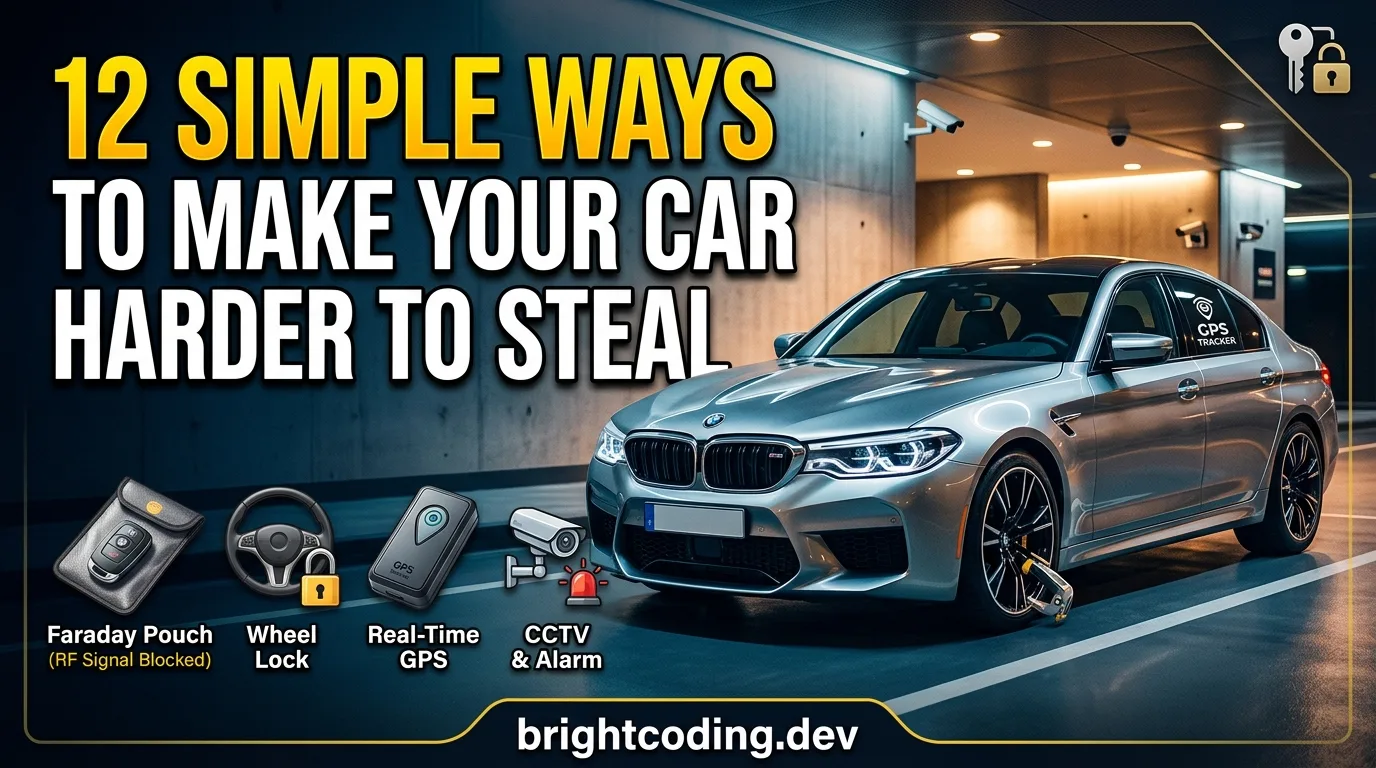
Your car is probably the second most expensive thing you own, and most people protect it with nothing more than a factory alarm and hope. That is a bad trade. A professional thief can be gone in under a minute, and the stuff you left on the passenger seat just makes the decision easier.
This article will not turn your sedan into a vault. It will, however, close the easy doors that most thefts go through, and it will save you from the specific mistakes that make a car look like a gift.
Why most people get this wrong
Car theft is rarely a Hollywood operation with wire cutters and a getaway van. It is usually opportunistic. Someone walks a parking lot, checks a few handles, spots a bag on a seat, and takes the path of least resistance.
The mistake is thinking about theft as a single event you either prevent or don't. In reality it is a series of small decisions: where you park, what you leave visible, whether your keys are in a bowl by the front door.
Most of the advice below costs nothing or close to nothing. The expensive stuff, the tracking systems and immobilizers, only matters after you have handled the free stuff first. Skip that order and you are paying for a lock on a door that is already open.
1 - Leaving the engine running to "warm up"
It is twenty degrees out, so you start the car, go back inside for coffee, and come out to an empty driveway. This is one of the most common theft setups in cold climates, and it happens in broad daylight.
People do it because it feels harmless. The car is right there, in your own driveway. Thieves know this too, and they specifically patrol residential streets in winter looking for exhaust plumes.
If you need to warm the car, stay in it, or use a remote starter that locks the doors and shuts the engine off if someone touches the brake. Never leave a running car unattended, even for sixty seconds at a gas station.
2 - Keeping a spare key inside the car
The classic hiding spots, the magnetic box under the wheel arch, the key in the center console, the fob in the glovebox, are the first places a thief checks. They are not secrets. They are traditions.
People keep a spare in the car for convenience, usually after locking themselves out once. The consequence is that a broken window becomes a full theft instead of a glass repair bill.
Carry the spare in your wallet or leave it with someone you trust. If you must stash one, it does not belong anywhere inside or attached to the vehicle.
3 - Parking like it doesn't matter
You park at the back of a dark lot because it is empty and you are in a hurry. That is exactly where someone can work without being seen.
Thieves prefer isolation, poor lighting, and no foot traffic. A spot near the entrance under a camera is annoying to walk to and much harder to steal from.
Choose well-lit, high-visibility spots, ideally near building entrances or security cameras. Back into the space if you can, it makes the car harder to tow and easier to spot if someone is messing with it.
4 - Treating the factory alarm as enough
A factory system is decent at what it does, which is mostly noise. It does not stop a determined thief and it does not text you when something happens.
People assume the little blinking light on the dash means the car is protected. It means the car has an alarm. Those are not the same claim.
If you want real coverage, look at a properly installed aftermarket system with a shock sensor, or at minimum a visible steering wheel lock. Visible deterrence beats invisible electronics in most real-world thefts.
5 - Ignoring the VIN and key cloning risk
Your VIN is visible through the windshield. That is normal. What is not normal is handing out your VIN and key code to anyone who asks, including some "locksmith" listings online.
People do this when they need a spare key made quickly and cheaply. A cloned key or a key cut from your VIN is a clean, quiet theft with no broken glass.
Use a reputable dealer or a licensed locksmith you contacted yourself, and never post your VIN publicly in a for-sale ad or forum thread. If you are buying a used car, a history check is worth the small fee.
6 - Leaving valuables in plain sight
A laptop bag on the back seat, a phone mount with the phone still attached, a jacket draped over something. Every one of those is an invitation.
The logic people use is "it's just a bag, nobody wants it." Thieves don't know what's in it. They assume it's worth a window.
Put everything in the trunk before you arrive at your destination, not after you park. If someone is watching the lot, moving the bag into the trunk in front of them tells them exactly where to look later.
7 - Assuming your car is too boring to steal
Nobody steals a ten-year-old economy sedan, right? Wrong. Older cars without immobilizers are often easier targets than new ones, and parts are always in demand.
This mindset is the reason so many people skip basic precautions. The consequence is that the least protected cars get hit most often.
Protect whatever you drive. A steering wheel lock and a locked glovebox on an older car are cheap insurance, and they cost less than your deductible.
8 - Skipping the wheel lock because it looks ugly
It does look ugly. That's the point. A bright yellow bar across the steering wheel tells a thief to move to the next car.
People skip it because it is inconvenient to put on and take off, especially for short trips. That is exactly when cars get taken, the quick run into the store.
Use it when you park somewhere unfamiliar, overnight, or for more than a few minutes. The two seconds it takes is nothing compared to a police report.
9 - Leaving the garage open and the keys visible
A garage door left open with a car inside, keys hanging on a hook by the door, is a five-second theft. This is one of the most common home-adjacent car theft scenarios, and it is entirely preventable.
People leave the garage open while doing yard work or carrying in groceries. It feels like a private space. It isn't.
Close the garage when you are not actively in it, and keep keys out of sight from any window or doorway. A simple hook inside a closed cabinet is enough to break the habit.
10 - Not knowing your car's weak points
Every model has known weak spots. Some are easy to unlock with a slim jim, some have a vulnerable keyless entry relay, some have a trunk release that can be reached through a gap.
Owners don't research this because it sounds paranoid. But a quick search on your specific make and model can tell you exactly what to guard against.
Spend ten minutes reading owner forums or a model-specific guide for your car. If you ever get a warning light after someone has been poking around, a free OBD code lookup at /obd can tell you whether something electrical was disturbed.
11 - Ignoring the keyless entry relay trick
If your car has push-button start, your key fob is broadcasting a signal constantly. Thieves can amplify that signal from outside your house and drive off while your keys sit on the hallway table.
People don't know this is possible, so they don't defend against it. The fix is simple and cheap.
Store your fobs in a signal-blocking pouch or metal box at home, and keep them away from the front door. Some cars let you disable keyless entry entirely, check your owner's manual.
12 - Never using a tracking or recovery option
This is the last line of defense, not the first. If your car does get taken, a tracker is the difference between a recovery and an insurance payout that never quite covers the loss.
People skip this because it feels like admitting defeat. In reality it is just another layer, like a second lock on your front door.
A basic GPS tracker or a factory connected service is worth considering if you drive something desirable or park on the street. Pair it with a mechanical deterrent and you have covered both the "don't get taken" and "get it back" scenarios.
Do this instead
Lock the doors every single time, even in your own driveway. That one habit prevents more thefts than any gadget.
Keep the spare key on your person, never in the car. Park in the light, in view, near people. Hide everything before you arrive, not after.
Use a visible deterrent like a steering wheel lock or a flashing LED. Store key fobs in a blocking pouch at home. Close the garage. Don't hand out your VIN.
And if your car ever starts acting strange after an attempted break-in, run the symptoms through the car symptom finder at /symptom before you assume it is a coincidence. The right layer of protection depends on your car and your situation, but the basics above are free and they work.
FAQ
Is a steering wheel lock actually effective?
Yes, mostly as a visual deterrent. It won't stop a determined thief with power tools, but it pushes most opportunistic thieves to an easier target. That is the goal.
Can thieves really clone my key fob?
They can relay the signal from a keyless fob to unlock and start some cars. The fix is to block the signal at home with a pouch or metal container, or disable keyless entry if your car allows it.
Does my factory alarm do anything?
It makes noise and may disable the ignition on some models. It does not notify you and it does not stop a fast thief. Treat it as a baseline, not a solution.
What is the single most effective thing I can do?
Lock your doors and never leave the car running unattended. Those two habits eliminate the majority of easy thefts. Everything else is a layer on top.
Should I install a GPS tracker?
If you park on the street, drive a commonly stolen model, or just want recovery options, a tracker is worth the cost. It won't prevent theft, so pair it with a mechanical deterrent.
The best anti-theft setup is boring: locked doors, nothing visible, and one obvious deterrent that makes your car look like more trouble than the next one.
Ready to act on what you just read? Decode that warning light with the free OBD code lookup, run the matching car tools to check the numbers yourself, or browse more practical car articles for ideas.
Related articles

10 Signs Your Petrol or Diesel Engine Is Starting to Fail
Your engine rarely dies without warning. It whispers first, then talks, then screams. Most drivers only start listening at the screaming stage, which is when the repair bill has already tripled.
Read the article →
Petrol vs Diesel: Which Engine Is Cheaper to Maintain?
You are standing in a dealer lot or scrolling through listings, and the same question keeps surfacing: petrol or diesel? The sticker price is only half the story. What you actually pay over five or seven years depends on servicing, parts, fuel, and how the car is driven. That is where the petrol vs…
Read the article →
Petrol vs Diesel Engine: Which One Is Really Better in 2026?
Buying a car in 2026 means you cannot dodge the petrol versus diesel question, especially if you are shopping used or looking at a nearly-new car that still has a combustion engine under the hood. Read this and you will know how to match the engine to your actual driving, work out what the fuel and…
Read the article →
Carburetor vs. Fuel Injection: Which System Is Better?
You already know the short answer: fuel injection wins on paper. It has won in showrooms for decades, and there is no serious argument left about which system meters fuel more precisely. So why does the question still come up in the bay every week?
Read the article →
How to Parallel Park Like a Pro: Simple Tricks That Work
Parallel parking is the one driving skill most people never really learn. They pass the test, then spend the next twenty years circling the block for a spot they can just pull into. That ends today.
Read the article →
Gasoline Fuel Injection Systems Explained: The No-BS Guide to MPI, GDI, PFI, and Everything In Between
Confused by MPI, GDI, PFI, and dual injection? You’re not alone. no-BS guide breaks down every gasoline fuel injection system in plain English how they work, where they spray, and which one is best for your car. Learn real differences, common symptoms, and maintenance tips without textbook jargon.
Read the article →