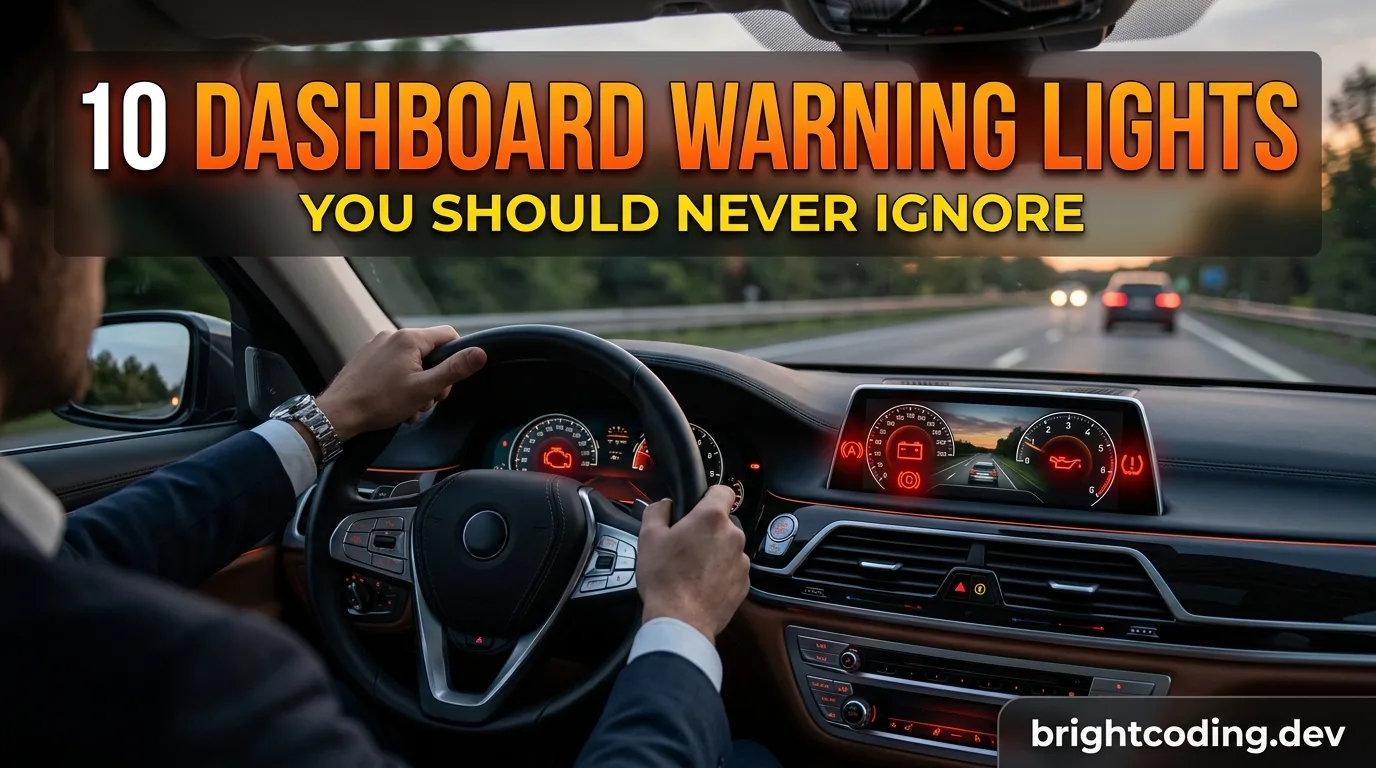
10 Dashboard Warning Lights You Should Never Ignore
Your dashboard isn't trying to annoy you. It's the only part of the car that talks to you in plain language — and it's often the cheapest warning you'll ever get. Ignore the wrong one and a $150 repair becomes a $2,000 repair, or a breakdown on the shoulder of a highway at 11 p.m.
Your dashboard isn't trying to annoy you. It's the only part of the car that talks to you in plain language — and it's often the cheapest warning you'll ever get. Ignore the wrong one and a $150 repair becomes a $2,000 repair, or a breakdown on the shoulder of a highway at 11 p.m.
This isn't about memorizing all 40-odd symbols. It's about knowing which lights mean "pull over now" and which mean "deal with this by Friday." Get that distinction right and you'll save real money and avoid some genuinely dangerous situations.
Why most people get this wrong
Dashboard lights come in three flavors, and people treat them all the same. Red means stop. Amber means something's wrong, but you usually have time. Green and blue just mean a feature is on.
The problem is that a lot of drivers see any light and either panic or shrug. Both reactions cost you. Panic sends you to a shop for something you could have diagnosed yourself. Shrugging sends you down the road with a failing water pump.
There's also a psychological trap: lights that flicker on and off get ignored fastest. If it went away, it can't be serious, right? Wrong. Intermittent is often the early stage, before it becomes permanent.
And here's the thing nobody tells you — the same warning light can mean something trivial or something catastrophic depending on your car and the context. That's why the manual matters more than any internet list, including this one. But the ten mistakes below are the ones that actually bite people.
1 — Treating the check engine light as decoration
You've seen it for three weeks. The car drives fine. So it's fine.
That's the most expensive assumption on this list. A steady check engine light is often something small — a loose gas cap, a failing oxygen sensor, a misfire you can't feel yet. But an unfixed misfire dumps raw fuel into your catalytic converter, and that converter is a four-figure part on many cars.
A flashing check engine light is different. That's the car yelling. Flashing means active misfire that can destroy the converter in minutes. Pull over, shut it off, get it towed.
How to avoid it: Buy a cheap OBD2 scanner or use the free OBD code lookup to turn that light into an actual code. A code like P0420 tells you far more than "the light is on."
2 — Assuming the oil light means "low oil, top it up"
The oil pressure light is not a level gauge. If it comes on while you're driving, it usually means the engine has lost oil pressure — the pump isn't pushing oil where it needs to go.
People see it, think "I'll add a quart when I get home," and keep driving. Ten minutes later they've scored the bearings and the engine is scrap.
How to avoid it: If the oil light comes on at speed, pull over safely and shut the engine off immediately. Check the level once it's cool. If there's oil on the dipstick and the light persists, do not restart it — that's a tow.
3 — Ignoring the temperature gauge creeping up
This one sneaks up. The gauge doesn't jump — it climbs. You tell yourself it's a hot day. Then you smell something sweet and see steam.
Overheating warps cylinder heads and blows head gaskets. That's an engine-out repair on plenty of cars. The warning was sitting right there on the dash for ten minutes.
How to avoid it: If the temperature gauge climbs past normal, turn off the A/C, crank the heater to full (it pulls heat out of the engine), and get somewhere safe. Never open a hot cooling system — the mechanical encyclopedia explains why that's a hospital visit waiting to happen.
4 — Driving on a flashing or solid battery light
The battery light doesn't mean your battery is dead. It usually means your alternator has stopped charging it. The car is running on stored juice, and you have maybe 20 to 30 minutes of driving left before everything dies — often in the middle of a busy intersection.
People misread this constantly because the car feels totally normal right up until it doesn't.
How to avoid it: Turn off everything electrical you don't need — radio, A/C, phone charger. Head straight to a shop or home, whichever is closer. Don't start a long trip hoping it'll clear.
5 — Confusing the tire pressure light with a flat
The TPMS light comes on, you look at the tires, they look fine, you keep driving. It's a slow leak, or a sensor battery dying, or cold weather dropping pressure.
Here's the trap: a tire that's 25% under-inflated looks completely normal but overheats at highway speed. That's how blowouts happen. And a genuinely flat tire driven even a mile or two is ruined.
How to avoid it: Check all four tires with an actual gauge — not your eyes — within the same day. If you're changing wheel or tire sizes, the tire size comparison tool will show you how much your speedometer and pressures are affected.
6 — Panicking over the ABS light and slamming on the brakes
The ABS light means your anti-lock braking system is offline. Your regular brakes still work. People either ignore it for months or treat it like a total brake failure.
The real risk is subtler: without ABS, your wheels can lock under hard braking, and you lose steering control in a panic stop. On dry pavement you might never notice. On rain or ice, that's where it matters.
How to avoid it: You can usually drive gently to a shop, but treat wet and icy roads with real caution until it's fixed. Don't test your brakes by stomping them on a public road.
7 — Clearing the airbag light and calling it fixed
The SRS or airbag light is the one people most want to make disappear. Clearing the code makes the light go out and makes you feel better. It does not make your airbags work.
A fault here can mean an airbag won't deploy in a crash — or worse, deploys at the wrong time. This is a safety system, not a nuisance light.
How to avoid it: Don't clear it and forget it. If you're curious what the underlying code points to, the AI mechanic assistant can help you interpret it before you talk to a shop.
8 — Ignoring the coolant or washer-fluid light because "it's just a light"
Fine, the washer-fluid light is genuinely harmless. But people lump it in with the coolant light and ignore both.
Low coolant is a slow leak somewhere — a hose, a water pump, a radiator. It won't stay low; it'll keep dropping until the engine overheats. You've seen this movie already in mistake number three.
How to avoid it: Top up coolant to the correct level (a 50/50 mix, not straight water), then watch it over the next week. If it drops again, you have a leak to chase.
9 — Believing "it drives fine, so it's fine"
This is the meta-mistake. A car can drive perfectly while quietly destroying itself. A failing transmission often shifts fine right up until it doesn't. A worn timing belt gives no warning at all before it snaps.
"You can't feel it" is not the same as "nothing's wrong."
How to avoid it: When a light stays on, spend ten minutes learning what it means rather than waiting for symptoms. The step-by-step car guides walk through the common ones without jargon.
10 — Waiting for a warning light before checking anything
The final mistake is treating the dashboard as your only maintenance reminder. By the time a light comes on, something has usually already gone wrong.
Fluids, belts, brake pads, and tire tread all wear predictably. Checking them on a schedule catches problems while they're still cheap. The free car tools here can help you keep that kind of check simple.
How to avoid it: A five-minute monthly walkaround — fluids, tires, lights — beats a dashboard full of surprises every time.
Do this instead
- Know your three colors: red means stop now, amber means diagnose soon, green means it's just a feature.
- Keep a cheap OBD2 scanner in the glovebox, or use the free OBD code lookup the moment a light appears.
- Read the owner's manual for the lights specific to your car — the same symbol means different things on different models.
- Never clear a code without understanding it first. Clearing isn't fixing.
- If it's red, flashing, or accompanied by steam, smoke, or noise — stop and tow it. Don't gamble.
FAQ
Is it safe to drive with the check engine light on? Yes, if it's steady and the car feels normal — get it scanned within a few days. No, if it's flashing or the car is misfiring, shaking, or losing power. That's a park-it-and-tow situation.
Can I just disconnect the battery to reset a warning light? You can, and it'll often go out. But you've wiped the code the mechanic needs and fixed nothing. The light will come back, usually at the worst possible time.
Why does my tire pressure light come on when it's cold? Cold air is denser and takes up less space, so pressure drops. A 10°F drop can knock pressure down a couple of PSI. Check and top up, then see if it stays on.
My oil light flickers at idle but goes out when I rev. Is that serious? Yes. That's classic low oil pressure, often from a worn pump or a clogged pickup. Get it checked before you drive it much further.
Do warning lights ever lie? They can be triggered by a bad sensor rather than a real fault. That's why you read the code instead of guessing from the light alone.
A warning light is your car asking for help in the cheapest way it knows how — answer it early, and you'll rarely pay the expensive version of that conversation.
Related articles

10 Signs Your Petrol or Diesel Engine Is Starting to Fail
Your engine rarely dies without warning. It whispers first, then talks, then screams. Most drivers only start listening at the screaming stage, which is when the repair bill has already tripled.
Read the article →
Petrol vs Diesel: Which Engine Is Cheaper to Maintain?
You are standing in a dealer lot or scrolling through listings, and the same question keeps surfacing: petrol or diesel? The sticker price is only half the story. What you actually pay over five or seven years depends on servicing, parts, fuel, and how the car is driven. That is where the petrol vs…
Read the article →
Petrol vs Diesel Engine: Which One Is Really Better in 2026?
Buying a car in 2026 means you cannot dodge the petrol versus diesel question, especially if you are shopping used or looking at a nearly-new car that still has a combustion engine under the hood. Read this and you will know how to match the engine to your actual driving, work out what the fuel and…
Read the article →
Carburetor vs. Fuel Injection: Which System Is Better?
You already know the short answer: fuel injection wins on paper. It has won in showrooms for decades, and there is no serious argument left about which system meters fuel more precisely. So why does the question still come up in the bay every week?
Read the article →
How to Parallel Park Like a Pro: Simple Tricks That Work
Parallel parking is the one driving skill most people never really learn. They pass the test, then spend the next twenty years circling the block for a spot they can just pull into. That ends today.
Read the article →
Gasoline Fuel Injection Systems Explained: The No-BS Guide to MPI, GDI, PFI, and Everything In Between
Confused by MPI, GDI, PFI, and dual injection? You’re not alone. no-BS guide breaks down every gasoline fuel injection system in plain English how they work, where they spray, and which one is best for your car. Learn real differences, common symptoms, and maintenance tips without textbook jargon.
Read the article →